
Negotiate Your Remote Salary: Scripts & Benchmarks for Filipinos (2026)
Copy-paste salary negotiation scripts for Filipino remote workers. Includes 2026 salary benchmarks by role, tips for countering geo-based pay, and real examples.

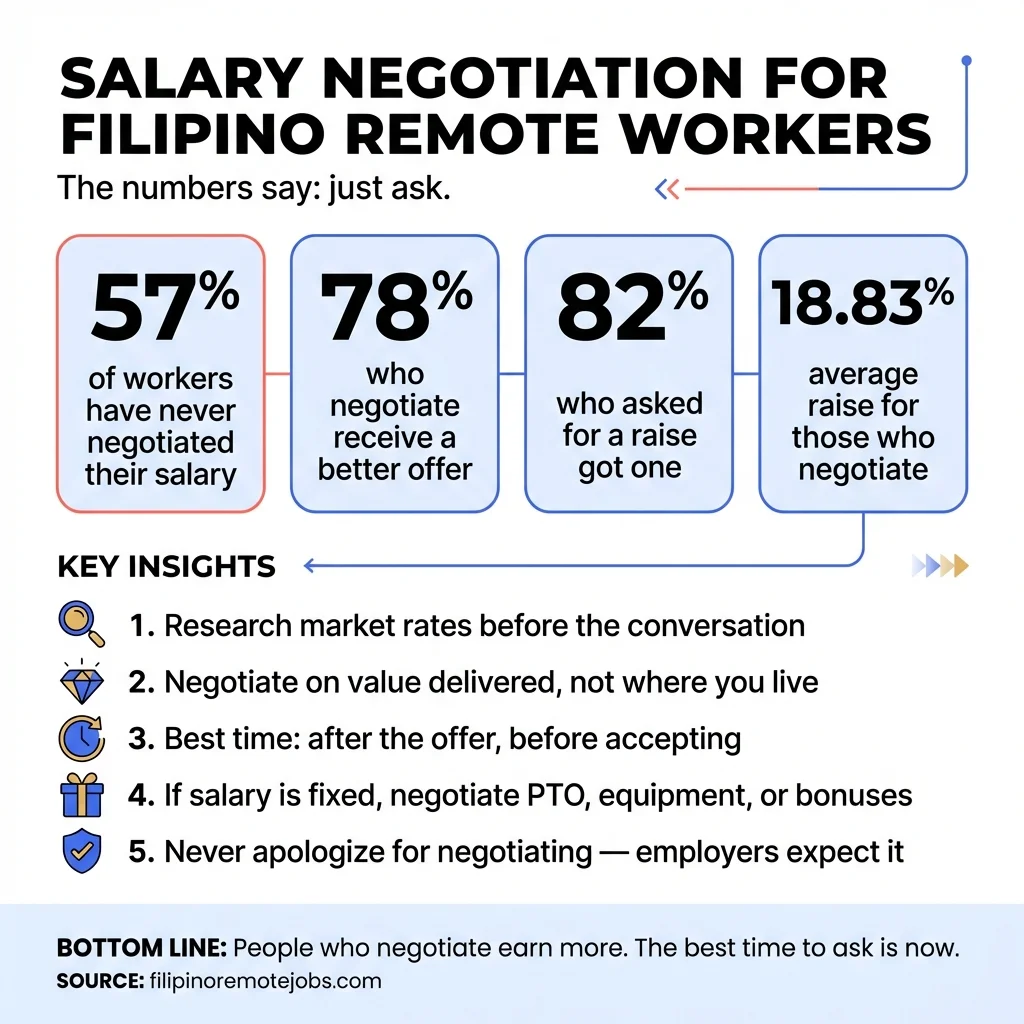
Here's a number that might sting: 57% of workers have never negotiated their salary. Among Filipino remote workers, that number is likely even higher. Cultural norms around "hiya" (the deep-rooted value of modesty and avoiding confrontation), combined with a lack of Philippine-specific salary data, mean most Filipino remote workers accept the first offer they receive — leaving tens of thousands of pesos on the table every month.
But here's what the data says about the other side: 78% of workers who negotiate receive a better offer, and employees who ask for more gain an average raise of 18.83%. International employers expect negotiation. When you don't ask, you're not being polite — you're being underpaid.
This guide gives you everything you need: Philippine salary benchmarks, the cultural reframe, and four copy-paste scripts you can use today.
Why Filipino remote workers don't negotiate (and why you should)
A 2022 study found that 78% of Filipino employees value harmonious relationships more than direct confrontation in workplace issues. That's "hiya" at work — the instinct to maintain peace, avoid seeming pushy, and show gratitude rather than make demands.
In a Filipino context, negotiating can feel like you're being "maarte" (difficult) or ungrateful. Add the fear that an employer might withdraw the offer entirely, and it's easier to just say "yes" and move on.
But here's what actually happens when people negotiate:
- 82% of workers who asked for a raise got one (LendingTree, 2024)
- 85% of Americans who negotiated a job offer were successful in getting at least some of what they asked for (Fidelity Investments)
- Only 30% of workers even bother to ask (Pew Research, 2023)
That last number is the opportunity. Most people don't negotiate — so when you do, you stand out as someone who knows their value. Western employers don't see negotiation as pushy. They see it as professional.
"You have the most power after an offer is made but before you accept it." — Martin Latz, CEO of Latz Negotiation
The goal isn't to erase "hiya" — it's to balance it with confidence. You can negotiate with tact and grace. The scripts later in this guide show you exactly how.
Know your worth: research before you negotiate
The biggest mistake in any negotiation is walking in without numbers. Before you discuss salary, spend 30 minutes researching what your role actually pays.
Where to find Filipino remote salary data
- OnlineJobs.ph — Browse job postings in your role to see listed salary ranges
- HireTalent.ph salary survey — Annual survey of 2,000+ Filipino remote professionals
- PayScale and Glassdoor — Filter by "Philippines" for local benchmarks
- Reddit communities — r/buhaydigital and r/phcareers have honest salary threads where workers share real numbers
Here are current benchmarks for common remote roles (USD/month, full-time):
| Role | Entry-Level | Mid-Level | Specialist |
|---|---|---|---|
| General VA | $400–$700 | $700–$1,100 | $1,100–$1,600 |
| Customer Support | $450–$700 | $700–$1,020 | $1,020–$1,400 |
| Content Writer | $600–$810 | $810–$1,200 | $1,200–$1,500 |
| Web Developer | $800–$1,200 | $1,200–$2,000 | $2,000–$3,500 |
| Social Media Manager | $500–$830 | $830–$1,350 | $1,350–$2,000 |
| Graphic Designer | $500–$810 | $810–$1,200 | $1,200–$1,700 |
Sources: HireTalent.ph 2026 survey, EOStaff 2025, ScoutTalented 2025
These ranges are for direct-hire remote positions. Agency rates can be very different (often higher for the client, but lower for you after the agency cut). If you're working through an agency and these numbers look high, that's a sign direct-hire might be worth exploring.
Also worth knowing: Filipino remote worker salaries have been rising 5–10% annually, with top talent seeing 15–20% increases since 2023. The market is moving in your favor.
USD vs PHP: which currency to quote
Quote in USD when you're working with international clients as a contractor. This is standard for remote work and protects you from exchange rate fluctuations. If the peso weakens against the dollar, your effective earnings go up.
Quote in PHP when working with Philippine-based companies or through an Employer of Record (EOR) setup where you're classified as a local employee.
If an employer asks for your rate in PHP and you'd prefer USD, a simple response: "I typically quote in USD since the role serves an international team — would that work for you?" Most will say yes.
For more on managing international payments, check out our comparison of Wise, PayPal, and Payoneer for Filipino freelancers.
The "cost of living" trap (and how to counter it)
This is the most common objection Filipino remote workers face: "We adjust salaries based on local cost of living."
Some companies use geo-based pay structures where workers in lower-cost countries receive lower salaries. Google and Meta do this. Others, like Buffer and Zillow, pay the same rate regardless of location because they believe same work deserves same pay.
Geo-based adjustments aren't inherently unfair. But they become unfair when employers use "cost of living" as a blanket excuse to pay you well below market rates for Filipino remote workers.
How to tell the difference:
- Fair geo-based pay: The offer falls within the market range for Filipino remote workers in your role and experience level (see the table above)
- Lowballing disguised as geo-pay: The offer is well below market, and the employer cites "Philippines cost of living" as the only reason
The reframe: Don't argue about cost of living. Redirect to value.
Here's a script that works:
"I appreciate the offer and understand your approach to location-based compensation. I'd love to discuss this based on the value I'll bring to the team. Based on my research, the market rate for this role with my experience level is [range]. I'd be comfortable at [your number], which reflects both the quality of work I'll deliver and current market rates for Filipino remote professionals."
This works because it doesn't attack their compensation philosophy — it simply adds your value to the equation.
When to negotiate (timing is everything)
Not every moment is the right moment. Here are the four best windows:
1. After receiving a job offer, before accepting. This is your strongest position. The company has decided they want you. They've invested time interviewing and evaluating candidates. They don't want to start over.
2. After 3–6 months of proven performance. OnlineJobs.ph notes that Filipino freelancer communities generally expect raises after at least 6 months, typically $1–$2/hour. If you started at a lower rate to "prove yourself," this is when you have the track record to back up an increase.
3. When your role has expanded. If you were hired as a VA handling emails and calendars, but now you're managing social media, onboarding new hires, and running reports — your role has changed. Your pay should too.
4. At annual review time. Even if your employer doesn't have a formal review process, you can create the moment: "It's been a year since we last discussed compensation. Could we schedule a quick call to review?"
Salary negotiation scripts for Filipino remote workers
These are ready to copy, customize, and send. Adjust the specifics to match your situation.
Script 1: Negotiating an initial job offer
Use this when you receive an offer that's below your target range.
Subject: Re: Job Offer — [Role Name]
Hi [Name],
Thank you so much for the offer — I'm genuinely excited about this role and the team. After reviewing the details and doing some market research, I'd like to discuss the compensation.
Based on current market rates for [role] with [X years] of experience, and the scope of responsibilities outlined, I was expecting something closer to $[your number]/month. This reflects the value I'll bring, including [specific skill or experience relevant to their needs].
Is there flexibility to adjust the rate? I'm confident we can find a number that works for both of us.
Looking forward to your thoughts.
Best, [Your name]
Why this works: It leads with gratitude (addressing the "hiya" instinct), cites research (not just feelings), highlights specific value, and invites collaboration rather than issuing a demand.
Script 2: Asking for a raise after 6+ months
Before sending this, prepare a brief list of your wins and contributions.
Hi [Name],
I've really enjoyed working together over the past [X months], and I wanted to have a conversation about my compensation.
Since I started, I've [taken on X additional responsibility], [improved Y process], and [delivered Z result]. I'm committed to continuing to grow in this role.
Based on the expanded scope and current market rates, I'd like to discuss adjusting my rate to $[new number]/month. Would you be open to a quick call this week to talk it through?
Thanks for your time, [Your name]
Tip: Keep a running document of your wins throughout the year — projects completed, positive client feedback, problems solved. When it's time to negotiate, you'll have evidence ready.
Script 3: Countering a lowball offer
If an offer comes in well below market rate:
Hi [Name],
Thank you for the offer. I'm excited about the opportunity and want to make this work.
I've done some research on current rates for [role] at this experience level, and the offer is below the market range I'm seeing ($[low end]–$[high end]/month for Filipino remote professionals). Would it be possible to meet closer to $[your number]?
I'm confident in the value I can bring to [specific area they care about], and I'd love to get started.
Best, [Your name]
Script 4: When they say "we can't increase the budget"
If salary is truly fixed, negotiate other forms of compensation:
I understand the budget constraints. Would it be possible to discuss some of these alternatives?
- Equipment or internet allowance (₱2,000–₱5,000/month can make a real difference)
- Additional paid time off (including Philippine holidays like Holy Week and Christmas)
- A performance bonus structure (e.g., quarterly or annual)
- A professional development budget for courses or certifications
- A salary review after 3 months based on performance
Sometimes a "no" on salary is really a "not yet." A 3-month review clause gives both sides a path forward.
Beyond base pay: other things worth negotiating
Salary is just one piece of total compensation. Filipino remote workers often overlook these:
- Equipment and internet allowance — Many employers provide ₱3,000–₱10,000/month for internet and hardware. If they don't offer it, ask.
- Philippine holidays — You observe different holidays than your US or AU employer. Negotiate recognition of key ones: Holy Week, All Saints' Day, Christmas through New Year.
- 13th month pay — Required by law for employees, but contractors can negotiate it too. Some employers already include it voluntarily.
- Schedule flexibility — If you're on a graveyard shift, negotiate flexibility on start times or compressed work weeks.
- Professional development — Courses, certifications, conference tickets. This benefits both you and your employer.
- Performance bonuses — Tie a portion of your compensation to measurable outcomes you can control.
Common mistakes to avoid
Accepting immediately. Even if the offer is good, take 24–48 hours. Saying "Let me review the full details and get back to you" is perfectly professional and gives you time to research.
Apologizing for negotiating. Don't say "I'm sorry to ask, but..." or "I hope this isn't too much, but..." You're having a professional conversation, not asking for a favor.
Anchoring to BPO salaries. If you came from a call center earning ₱18,000–₱25,000/month, it's tempting to see $500/month as a huge upgrade. But the remote market pays differently. Use remote salary benchmarks, not local BPO rates, as your reference point.
Sharing your current salary. When asked "What's your current rate?", deflect: "I'd prefer to discuss compensation based on the scope of this role and current market rates. I'm looking for something in the range of $[X]–$[Y]."
Negotiating over chat when you could do video. Text loses tone. If the conversation is about money, suggest a quick Zoom or Google Meet call where you can read reactions and adjust in real time.
Real examples: before and after negotiation
Example 1: The VA who sent one email. A general VA in Cebu received an offer of $500/month for a full-time role. She researched market rates, found the range was $700–$1,100 for her experience level, and sent a version of Script 1 asking for $750. The employer countered at $700 with a 3-month review. She accepted — a 40% increase from the original offer, from one email.
Example 2: The $4/hour worker who finally asked. A Filipino remote worker shared on r/buhaydigital that they'd been earning $4/hour for months while their responsibilities had tripled. The community validated that they were underpaid and encouraged them to negotiate. The lesson: if your role has grown but your pay hasn't, you're not being greedy by asking — you're correcting an imbalance.
Example 3: The designer who knew when to move on. Danny Coritao started his remote career at just over ₱10,000/month. After nearly a year of strong performance, his employer offered a 120% raise. Danny turned it down and found a new employer who gave him a 200% increase from his original salary. He went on to buy a motorcycle, build a house, and start a local business — all from remote work income. Sometimes the best negotiation is knowing your market value and finding an employer who meets it.
Frequently asked questions
Is it okay to negotiate salary in the Philippines? Yes. International employers expect it. A 2023 Pew Research study found that among workers who asked for more, two-thirds received a higher offer. You're not being rude — you're being professional.
How much of a raise should I ask for? Filipino freelancer communities typically expect $1–$2/hour increases after 6 months. For percentage-based asks, 10–20% is reasonable for strong performance and expanded responsibilities.
What if they say no? A "no" to salary doesn't mean "no" to everything. Ask about equipment allowances, PTO, bonuses, or a scheduled review. And a rejection today doesn't prevent you from asking again in 3–6 months.
Should I tell them my current salary? Avoid it if possible. Redirect to market rates and the value you'll deliver in the new role. Your current salary reflects your past situation, not your current worth.
Start negotiating from a position of strength
Negotiation isn't about confrontation — it's about having an honest conversation backed by research. Know the market rates for your role. Document the value you deliver. Use the scripts in this guide as a starting point, and adjust them to sound like you.
The data is clear: people who negotiate earn more. And in a market where Filipino remote worker salaries are rising 5–10% annually, there's never been a better time to ask.
Ready to find opportunities worth negotiating for? Browse remote jobs on Filipino Remote Jobs and go in prepared.
Want to stand out before the salary conversation even starts? Learn which in-demand skills command higher pay, or brush up on your remote interview technique to land the offer first.
Quick reference
Save this infographic for your next salary negotiation:
Get Remote Jobs in Your Inbox
Join Filipino professionals getting curated remote job opportunities delivered every week. No spam, unsubscribe anytime.
Share this article
About Filipino Remote Jobs Team
The Filipino Remote Jobs Team is dedicated to helping Filipino professionals find legitimate remote work opportunities with international companies. We provide career advice, job search tips, and insights to help you land your dream remote job.
Related Articles
Top 15 Highest Paying Remote Jobs in the Philippines (2026)
Discover the highest paying jobs in the Philippines for remote workers. Salary ranges in USD and PHP, skills needed, and how to break into each role.
SSS, PhilHealth & Pag-IBIG: The Complete Guide for Filipino Freelancers & Remote Workers (2026)
How to register, pay, and maximize SSS, PhilHealth, and Pag-IBIG as a Filipino freelancer. 2026 contribution tables, benefits, and pro strategies.
Freelancer Tax Guide Philippines: BIR Registration & Filing for Remote Workers (2026)
Complete guide to BIR registration and tax filing for Filipino freelancers and remote workers. Learn the 8% tax option, quarterly deadlines, and how to stay compliant while working for international clients.