
Remote Interview Tips: How to Ace Video Interviews with US Companies
Master video interviews for remote jobs with US companies. Filipino-specific tips for technical setup, common questions, one-way interviews, and backup plans.
Here's a reality check: 93% of employers plan to keep using video interviews as part of their hiring process. If you're applying for remote jobs with US companies, your first impression won't happen in a conference room—it'll happen through your webcam.
And increasingly, that first impression happens without anyone on the other end watching live.
One-way video interviews have increased by 67% since 2020. Companies use them to screen hundreds of candidates quickly, which means your recorded answers need to stand on their own. No friendly nods from the interviewer. No real-time feedback. Just you, the camera, and about 90 seconds to prove you're worth a live conversation.
The good news? Most candidates don't prepare properly for video interviews. If you nail the basics covered in this guide—technical setup, Philippine-specific backup plans, and the questions US companies actually ask Filipino candidates—you'll already be ahead of the competition.
Understanding remote interview formats
Before you prep, know what you're prepping for. Remote interviews come in two main formats, and they require different approaches.
Live video interviews
This is the format you probably picture: a real-time conversation over Zoom, Google Meet, or Microsoft Teams. You and the interviewer talk back and forth, just like an in-person interview but through screens.
For Filipino candidates, these often get scheduled during awkward hours. A 9 AM meeting in New York is 10 PM in Manila. A "quick call" with someone in San Francisco might mean you're interviewing at midnight. This is normal for remote work with US clients, so treat it as your first test of handling time zone differences gracefully.
One-way video interviews
These are becoming the standard first screening for remote positions. You receive a set of questions, record your answers on video (usually with time limits like 60-90 seconds per question), and submit. No live interviewer. Limited or no retakes.
Think of it like an audition tape. The hiring manager watches your recording later, often alongside dozens of other candidates' videos.
One-third of candidates quit applications that require one-way video interviews—which actually works in your favor if you're willing to do them well. Less competition.
Setting up your interview space
Your physical setup directly affects how professional you appear. According to hiring managers, 58% say a distracting background is a deal-breaker. Don't let your environment sabotage an otherwise strong interview.
Lighting that works
Natural light is your best friend, but it needs to face you, not sit behind you. A window behind your laptop turns you into a silhouette.
Position yourself so daylight comes from in front (ideally at a slight angle). If you're interviewing at night—common when your US interviewer is in their morning—a ring light or desk lamp aimed at your face does the job. Test your setup at the actual time you'll be interviewing, not just during the day.
Background and framing
Keep it simple. A plain wall, a tidy bookshelf, or a neutral corner of your room works fine. What doesn't work: unmade beds, hanging laundry, family members walking through, or the chaos of a shared living space.
Position your camera at eye level. If you're using a laptop, stack some books underneath so you're not looking down at the screen. Frame yourself from the shoulders up—close enough to see your expressions, far enough to include natural hand gestures.
Avoid virtual backgrounds unless the real one is truly unworkable. Hiring managers often see them as a red flag or distraction, and they can glitch awkwardly during the interview.
Audio quality
Bad audio is worse than bad video. Use earphones or a headset to prevent echo from your speakers feeding back into your microphone.
Test your mic before every interview. Record a quick voice memo and play it back—if it sounds muffled or echoey, troubleshoot before the real thing.
Close windows and doors. The tricycle passing by, the neighbor's videoke, the construction down the street—ambient noise that you've tuned out will be very audible to someone in a quiet office in Texas.
The Philippine backup plan
Let's address the elephant in the room: brownouts and internet outages. These are legitimate career risks for Filipino remote workers. A dropped connection during your interview can cost you the job—not because you're incompetent, but because the employer might question your reliability.
Don't let infrastructure issues derail your opportunity. Have a backup plan ready, and communicate it proactively.
Power backup
At minimum, keep your laptop fully charged before any interview. A charged laptop buys you 2-4 hours even if the power cuts out.
Better: invest in a UPS (uninterruptible power supply). An entry-level UPS like the APC BVX650I-PH costs under ₱3,000 and gives you instant switchover plus 10-30 minutes of backup power—enough to finish an interview or gracefully reschedule.
Know your area's brownout schedule if your power company publishes one (many do on Facebook). Schedule interviews around known outage times when possible.
Internet backup
Have a mobile data hotspot ready on a different network than your main ISP. If you use PLDT fiber, keep a Globe or Smart SIM loaded with data as backup. If your fiber goes down, you can hotspot from your phone within seconds.
If something does go wrong mid-interview, communicate immediately. A quick message like "I apologize—I'm experiencing a brief internet issue and reconnecting now" shows professionalism. Most interviewers understand; what they don't understand is candidates who disappear without explanation.
For a deeper dive on protecting your remote work setup, check out our complete guide to surviving brownouts while working from home.
Before the interview: preparation checklist
Preparation is where most candidates either win or lose. The actual interview is just the performance—the rehearsal happens before.
Research the company
Go beyond skimming the homepage. Check their LinkedIn company page for recent posts and employee count. Read their Glassdoor reviews (take the negative ones with appropriate skepticism, but note patterns). Search for recent news: funding rounds, product launches, leadership changes.
Understand their work culture. Are they remote-first or just remote-tolerant? Do they emphasize async communication or real-time collaboration? This context helps you tailor your answers and ask smarter questions.
If you've already optimized your LinkedIn profile, make sure the experience you highlight there matches what's relevant for this role.
Understand the role
Re-read the job description right before the interview. Note specific tools they mention (Slack, Notion, HubSpot, whatever), any KPIs or metrics, and time zone requirements.
Prepare 2-3 concrete examples from your past work that demonstrate the skills they're asking for. If they want someone who "works independently," have a story ready about a time you solved a problem without hand-holding. If they need "strong communication skills," think of an example where your communication prevented a misunderstanding or resolved a conflict.
Technical test run
Test the interview platform 24 hours before. Download any required software, create an account if needed, and do a test call (most platforms have this option). Test again one hour before the actual interview.
Have a backup device ready. Your phone can work in an emergency—it's not ideal, but it's better than missing the interview entirely.
Common questions US companies ask Filipino candidates
You'll face some questions that every remote candidate gets, plus some that are specifically aimed at Filipino applicants. Prepare for both.
The classics
"Tell me about yourself." Keep it 60-90 seconds. Focus on your professional background, not your life story. Structure it as: current role → relevant past experience → why you're excited about this opportunity.
"Why do you want to work remotely?" Don't say "I don't want to commute" or "I want to stay home." Talk about how remote work lets you do your best work—focused time, flexibility to work when you're most productive, the ability to support international teams across time zones.
"How do you handle working across time zones?" Show that you've thought about this. Mention specific strategies: blocking overlap hours for sync communication, using async tools effectively, being proactive about updates so teammates aren't waiting on you.
"Describe a time you solved a problem independently." This is huge for remote roles. They need to know you won't be pinging them every five minutes with questions. Use the STAR method: Situation (what was happening), Task (what you needed to do), Action (what you actually did), Result (what happened because of it).
Filipino-specific questions
US employers hiring Filipino remote workers often ask questions you won't find in generic interview guides:
"What's your internet setup like?" Be specific: "I have 100 Mbps fiber from PLDT, and I keep a Globe mobile data plan as backup." This reassures them you've thought about reliability.
"Do you have power backup?" If you have a UPS or generator, mention it. If you don't, explain your laptop battery capacity and how you'd handle an outage mid-call.
"Have you worked with US clients before?" If yes, great—share specific examples. If not, emphasize your experience with Western communication styles, English proficiency, or any international collaboration you've done.
"What are your available working hours?" Be honest about your flexibility. If you're willing to do graveyard shifts, say so. If you have constraints (kids, other commitments), mention them—better to set expectations now than disappoint later.
One-way video interview tips
One-way interviews require a different approach than live conversations. Without real-time feedback, you need to bring extra energy and preparation.
Energy and pacing
In a live interview, the other person's reactions—nodding, smiling, asking follow-ups—tell you you're on the right track. In a one-way recording, you get nothing. This absence makes many candidates come across as flat or nervous.
Compensate by bringing about 20% more energy than feels natural. Smile more than you normally would. Speak slightly slower than your natural pace—nerves tend to speed us up, and slower speech sounds more confident on camera.
One piece of advice that keeps coming up in Filipino remote worker communities: "Make a good story that sounds natural, not scripted or monotonous." Practice until your answers feel conversational, not rehearsed.
Time management
Most one-way interviews give you 60-90 seconds per question. Practice with a timer. Your answer should fill about 80% of the allowed time—long enough to be substantive, short enough to not get cut off.
Don't rush to fill silence. A brief pause to collect your thoughts looks confident. Rambling to avoid dead air looks unprepared.
Technical tips
Look at the camera lens, not the screen. This creates the illusion of eye contact. It feels unnatural—you want to look at the question text or your own face—but 64% of interviewers specifically prefer candidates who maintain camera eye contact.
Don't read from notes. Hiring managers can tell immediately when someone is reading. Glancing at brief bullet points is fine; reading paragraphs is obvious and off-putting.
Use retakes strategically. If the platform allows retakes, don't waste them on minor stumbles. Use them for answers where you genuinely blanked or said something wrong. A small "um" isn't worth re-recording; a factual error is.
After the interview: follow-up
The interview ends when you close your laptop. The process ends when they make a decision. What you do in between can tip the scales.
Send a brief thank-you email within 24 hours. Keep it short: thank them for their time, mention one specific thing you discussed (this shows you were paying attention), and express continued interest in the role.
Don't over-follow-up. One thank-you email is enough. Following up again a week later "just checking in" comes across as desperate. If they want to move forward, they'll contact you. If they don't, more emails won't change their mind.
Track your applications somewhere—a spreadsheet, Notion, whatever works. Note the company, role, interview date, what questions they asked, and any follow-up actions. This helps you improve for next time and keeps you organized when you're applying to multiple positions.
Land your next remote opportunity
Video interviews can feel awkward, but they're a skill you can practice. The candidates who succeed aren't necessarily the most talented—they're the ones who prepare their setup, anticipate the questions, and bring genuine energy to the screen.
Remember: companies using video interviews are placing trust in people they've never met in person. Your job is to prove you're dependable, professional, and capable of communicating clearly from a distance. That's exactly what remote work requires.
Ready to put these tips into practice? Browse remote job listings on Filipino Remote Jobs and find your next opportunity with US companies actively hiring Filipino talent.
Quick reference
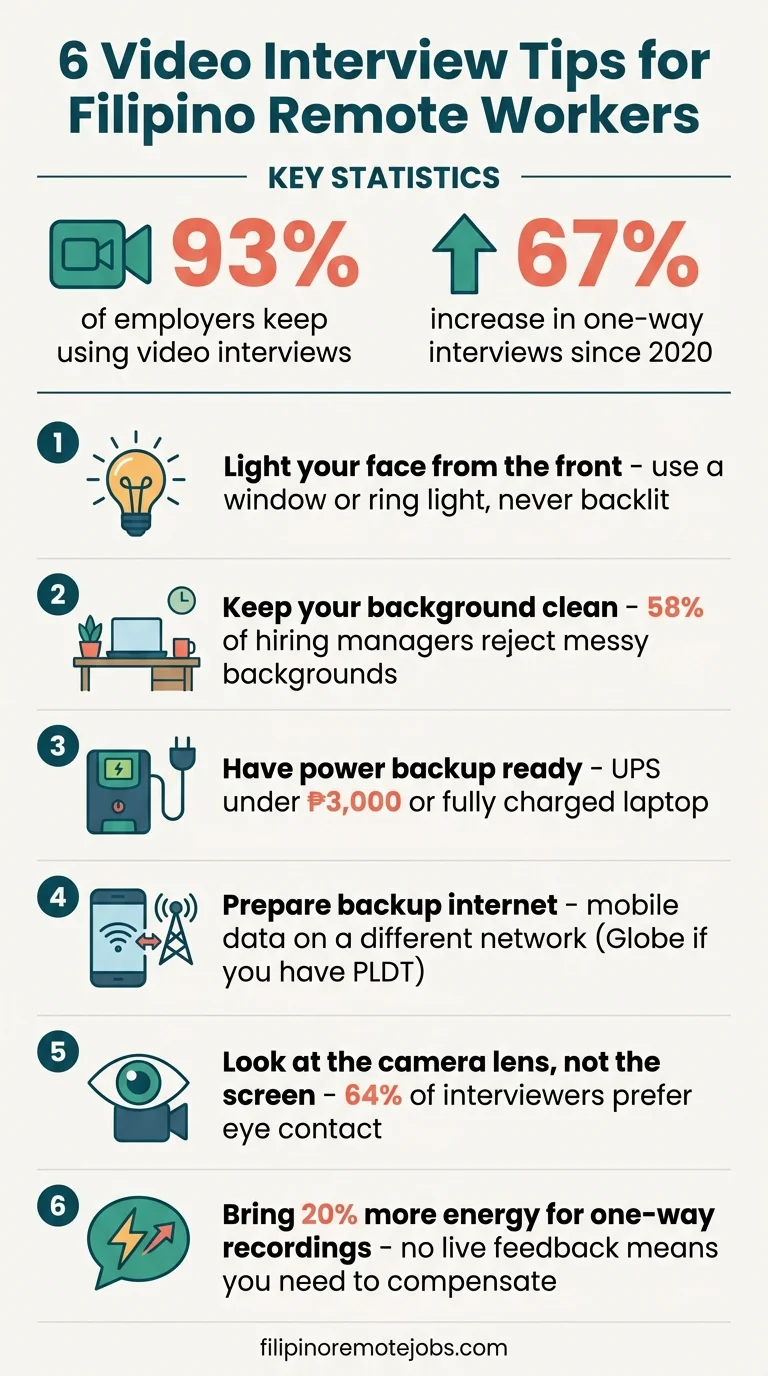
Save this infographic for your next video interview:
Get Remote Jobs in Your Inbox
Join Filipino professionals getting curated remote job opportunities delivered every week. No spam, unsubscribe anytime.
Share this article
About Filipino Remote Jobs Team
The Filipino Remote Jobs Team is dedicated to helping Filipino professionals find legitimate remote work opportunities with international companies. We provide career advice, job search tips, and insights to help you land your dream remote job.
Related Articles
How to Get a Remote Job in the Philippines: Complete Guide (2025)
Learn how to land a remote job as a Filipino worker. Step-by-step guide covering skills, where to apply, resume tips, and common mistakes to avoid.
Virtual Assistant Jobs in the Philippines: How to Get Started With No Experience (2026)
Want virtual assistant jobs in the Philippines but have no experience? This guide covers the exact skills, free training resources, and platforms to land your first VA role.
Online Part-Time Jobs Philippines: 20 Best Options (2026)
Find the best online part-time jobs in the Philippines with salary ranges, skill requirements, and where to apply. From data entry to web development.