
Night Shift Survival Guide: Health Tips for Filipino Remote Workers (2026)
Practical health tips for Filipino remote workers on US/EU time zones. Sleep strategies, meal timing, caffeine management, and staying healthy on the graveyard shift.

It's 3AM. You're on your third cup of coffee, your client just sent another urgent message, and your family is sleeping soundly in the next room. This is night shift work from home in the Philippines—the reality for thousands of remote workers serving US and European clients.
Working the graveyard shift (typically 9PM to 6AM Philippine time) comes with real benefits: higher pay differentials, peaceful focus time without daytime distractions, and access to international opportunities. But it also comes with real health challenges that you can't afford to ignore.
According to industry data, approximately 42.6% of BPO employees in the Philippines work night shifts. Among those workers, 93% report sleep problems. These aren't minor inconveniences—they're warning signs.
This guide covers practical, Filipino-specific strategies to help you survive and thrive on the night shift. Not generic advice copied from US healthcare websites, but real tips that work when you're working from home in a tropical country, living with family, and trying to maintain your health while the rest of the Philippines sleeps.
Why night shift is harder than you think
Your body wasn't designed for this. That's not a criticism—it's biology.
Every cell in your body runs on a 24-hour clock called your circadian rhythm. This internal system tells you when to sleep (night) and when to be alert (day). It's synchronized with sunlight, which is why your body naturally wants to wind down when it gets dark.
When you flip this schedule, you're fighting millions of years of human evolution. Your core body temperature drops around 3-4AM, melatonin (the sleep hormone) peaks, and cognitive function dips sharply. That 3AM struggle isn't in your head—it's hardwired into your biology.
The health stakes are real. Research shows night shift workers face increased risks of heart disease, diabetes, obesity, and depression. One UK Biobank study following over 283,000 workers found shift workers had a 12% increased hazard of all-cause mortality compared to day workers.
But here's the thing: these risks are significantly higher for workers who don't manage their health properly. With the right strategies, you can minimize the damage and build a sustainable night shift career. The key is taking it seriously—not treating health as something you'll "fix later."
Sleep like it's your job
Sleep isn't optional. It's the foundation everything else depends on.
Night shift workers need 7-9 hours of sleep per 24-hour period, just like everyone else. The difference is when you sleep—and that requires intentional effort.
Lock in your sleep schedule
Consistency matters more than perfection. Pick a sleep window and stick to it, even on weekends.
If your shift ends at 6AM, aim to be in bed by 7-8AM. Your body can adapt to almost any schedule, but it can't adapt to a schedule that changes every few days. The worst thing you can do is sleep during the day on workdays and switch to night sleep on your days off. This keeps your body in perpetual jet lag.
Create a blackout cave
Sunlight is your enemy when you're trying to sleep at 8AM.
Invest in blackout curtains—they make a real difference. The affordable ones from Shopee work fine. Add an eye mask for extra darkness. Your goal is to make your room as dark as midnight, even when the sun is blazing outside.
Temperature matters too. The Philippines is hot, but your body sleeps better when it's cool. If you have aircon, use it during sleep hours. If not, a good electric fan aimed at your bed helps significantly.
Manage noise
This is where living with family gets tricky. You're trying to sleep while everyone else is cooking breakfast, watching TV, and going about their day.
Talk to your family about your schedule. Explain that your sleep time is as important as a day worker's night sleep. Ask for quiet hours during your main sleep window. Most families will accommodate once they understand—this isn't you being difficult, it's you protecting your health and your income.
For noise you can't control, use white noise. A fan works, or download a white noise app on your phone. Some workers swear by earplugs, though these take getting used to.
Wind down properly
You can't go from a stressful client call straight to sleep. Your brain needs transition time.
Stop looking at screens at least 30 minutes before bed. The blue light from phones and laptops suppresses melatonin production, making it harder to fall asleep. If you must use devices, enable night mode or use blue light glasses.
Develop a pre-sleep routine: dim the lights, take a cool shower, do some light stretching, or read something boring. Your body will learn to associate these activities with sleep.
What to eat (and when) on night shift
Your digestive system also follows a circadian rhythm. It expects food during the day and rest at night. Working against this pattern requires strategy.
Meal timing that works
Eat your main meal before your shift starts—essentially, have dinner with your family in the evening. This gives your body time to digest while you're alert and active.
During your shift, stick to lighter snacks every few hours rather than one heavy meal at 3AM. Your body struggles to digest large meals in the middle of the night, leading to that sluggish, bloated feeling that makes staying alert even harder.
Before sleep, eat something light if you're hungry, but avoid heavy meals within 2 hours of bedtime. A small snack with protein (like a few boiled eggs or some cheese) can actually help you sleep.
Foods that help vs. hurt
Good choices for night shift:
- Protein (chicken, fish, eggs, tofu) for sustained energy
- Complex carbs (brown rice, whole wheat bread, oatmeal) for steady blood sugar
- Fruits and vegetables for nutrients and hydration
- Nuts and seeds for healthy fats and protein
What to avoid:
- Heavy fried food (hello, instant sisig at 2AM) that sits like a rock in your stomach
- Excessive sugar and junk food that cause energy crashes
- Instant noodles as a meal replacement—they're convenient but nutritionally empty
Filipino tip: an air fryer is your friend. Quick, healthy cooking without the hassle of deep frying.
Hydration strategy
Drink water consistently throughout your shift. Dehydration causes fatigue, headaches, and poor concentration—symptoms that feel a lot like sleep deprivation.
Keep a water bottle at your desk. If plain water bores you, add calamansi or cucumber slices.
Staying alert without destroying your health
The goal isn't just to survive until 6AM. It's to stay sharp, productive, and healthy while doing it.
Strategic caffeine use
Coffee is a tool, not a crutch. The key is "little and often."
Sleep scientists recommend about 50mg of caffeine every 2 hours (roughly half a cup of brewed coffee or one cup of tea). This maintains steady alertness without the jitters or the crash.
The critical rule: stop caffeine 4-6 hours before your planned sleep time. If you're sleeping at 7AM, your last coffee should be around 1-2AM at the latest. Yes, even if you think caffeine doesn't affect you—research shows it does, you just don't realize it's reducing your sleep quality.
Light exposure tricks
Use light strategically to work with your circadian rhythm.
During your shift, keep your workspace well-lit. Bright light signals "alert" to your brain. Some workers use daylight lamps for an extra boost, especially during the 3-4AM slump.
After your shift, do the opposite. Reduce light exposure as much as possible. Wear sunglasses if you need to go outside. Dim your phone screen. The goal is to tell your body that "nighttime" (your sleep time) is coming, even though the sun says otherwise.
Movement breaks
Sitting for 8+ hours wears down your body regardless of what shift you work.
Set a timer to stand up and move every hour. Walk around the house, do some stretching, or knock out a few bodyweight exercises. This keeps blood flowing, reduces back pain, and fights fatigue.
Bonus: exercising shortly after waking (in the evening for night shift workers) boosts energy for your upcoming shift. And in the Philippines, evening workouts are way more comfortable than sweating through a midday session.
Protecting your mental health
Night shift can be isolating. You're awake when everyone else sleeps. You miss family dinners, weekend mornings, and social events that happen during "normal" hours.
This isolation is real and it affects mental health. One Philippine study found that 78% of night shift call center agents showed symptoms of depression.
Stay connected
Make intentional effort to maintain relationships. Schedule video calls with friends, plan activities on your days off, and don't let work completely consume your social life.
For family, establish regular touchpoints even with opposite schedules. Maybe it's breakfast together when you get off work, or a quick dinner before your shift starts. These moments matter.
Watch for warning signs
Burnout sneaks up on you. Watch for these signals:
- Persistent exhaustion even after sleeping
- Cynicism or detachment from work
- Difficulty concentrating or making decisions
- Irritability that wasn't there before
- Dreading work more than usual
If these persist, something needs to change. Talk to someone—a friend, family member, or professional. Night shift is demanding, but it shouldn't destroy you.
Supplements worth considering
Working nights limits your sunlight exposure, which affects certain nutrients. Consider these (but always consult a doctor first):
Vitamin D: You're sleeping through peak sunlight hours, so deficiency is common among night shift workers. A daily supplement helps maintain bone health and immune function.
Melatonin: Low-dose melatonin (0.5-3mg) taken 30 minutes before sleep can help signal "bedtime" to your body. A 2025 clinical trial published in Occupational & Environmental Medicine found melatonin supplementation may help improve oxidative DNA damage repair in night shift workers. Don't overdo it—more isn't better.
Magnesium: Supports sleep quality and muscle relaxation. Many Filipinos don't get enough from diet alone.
B-vitamins: Support energy metabolism. Helpful if your diet isn't optimal (and let's be honest, whose diet is at 3AM?).
Supplements aren't magic pills. They support a healthy lifestyle—they don't replace one.
Setting up your night shift routine
Here's a sample schedule for a 9PM-6AM shift:
5:00 PM — Wake up, light exercise 6:00 PM — Dinner with family (main meal) 7:00 PM — Personal time, errands 8:30 PM — Pre-shift routine, prepare workspace 9:00 PM — Shift starts 12:00 AM — Light snack, coffee if needed 3:00 AM — Movement break, last coffee 6:00 AM — Shift ends 6:30 AM — Wind-down routine (dim lights, no screens) 7:00 AM — Sleep
On days off, try to maintain similar sleep timing. Shifting completely to "normal" hours and back creates constant jet lag. A compromise approach—staying up a bit later and sleeping in a bit later—minimizes disruption while still allowing some daytime life.
Make it sustainable
Night shift work isn't easy. Anyone who tells you otherwise hasn't done it.
But it can be sustainable if you respect what it demands from your body. Prioritize sleep like your career depends on it—because it does. Eat intentionally. Use caffeine strategically. Protect your mental health. Build routines that support you.
The Filipino remote workers who thrive long-term on night shift aren't superhuman. They're just disciplined about the basics.
If you're looking for remote opportunities that might offer more flexibility with hours, or if you're ready to find your next role, browse our current job listings. And for more remote work tips, check out our guides on surviving brownouts while working from home and AI tools to work more efficiently.
Take care of yourself. The graveyard shift is a marathon, not a sprint.
Quick reference
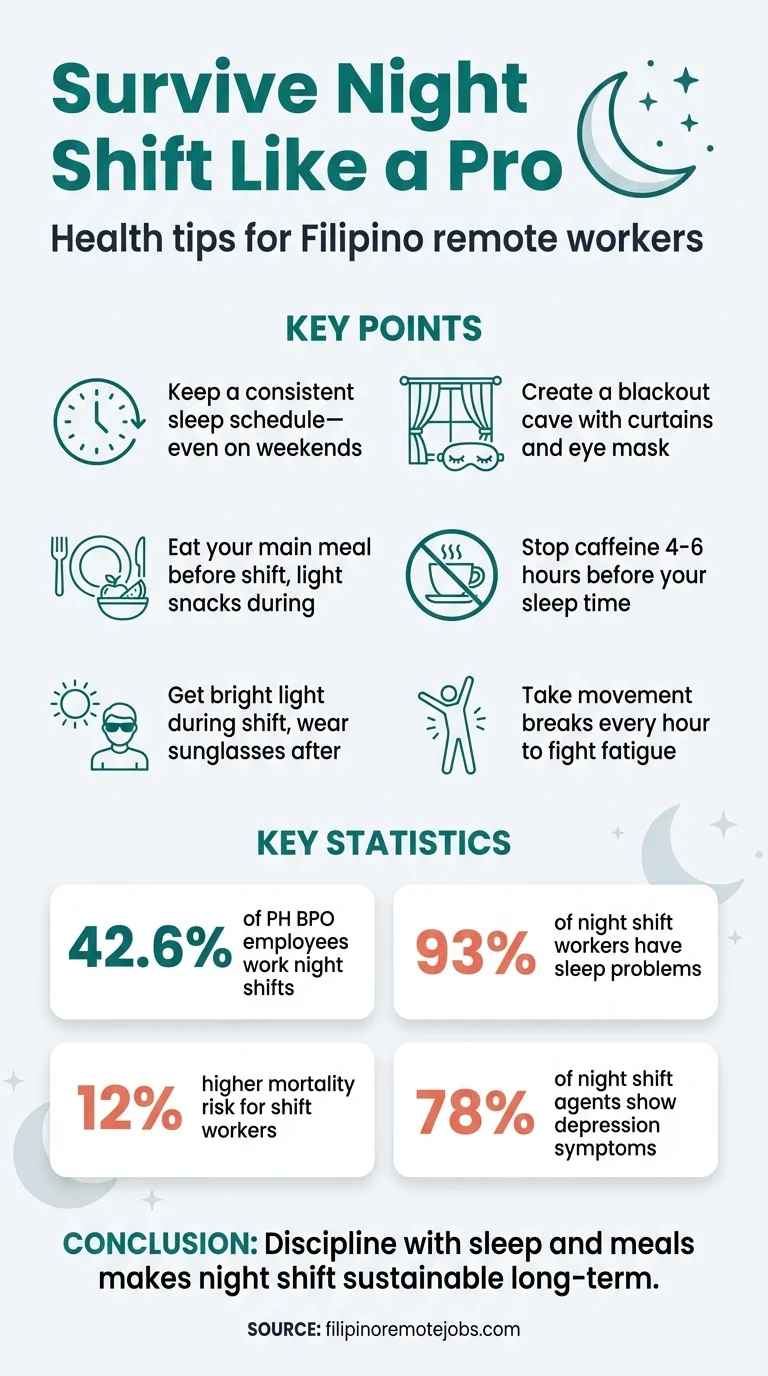
Save this infographic for healthier night shifts:
Get Remote Jobs in Your Inbox
Join Filipino professionals getting curated remote job opportunities delivered every week. No spam, unsubscribe anytime.
Related Topics
Share this article
About Filipino Remote Jobs Team
The Filipino Remote Jobs Team is dedicated to helping Filipino professionals find legitimate remote work opportunities with international companies. We provide career advice, job search tips, and insights to help you land your dream remote job.
Related Articles
Surviving Brownouts: Complete WFH Power Backup Guide for Filipino Remote Workers (2026)
Practical guide to working from home during brownouts in the Philippines. Budget-friendly power and internet backup solutions, plus client communication templates.
How to Hire a Filipino Virtual Assistant: The Complete 2026 Guide
How to hire a Filipino virtual assistant in 2026 — what to pay, where to find them, how to screen, onboard, and avoid costly mistakes.
Virtual Assistant Jobs in the Philippines: How to Get Started With No Experience (2026)
Want virtual assistant jobs in the Philippines but have no experience? This guide covers the exact skills, free training resources, and platforms to land your first VA role.