
How to Hire a Filipino Virtual Assistant: The Complete 2026 Guide
How to hire a Filipino virtual assistant in 2026 — what to pay, where to find them, how to screen, onboard, and avoid costly mistakes.

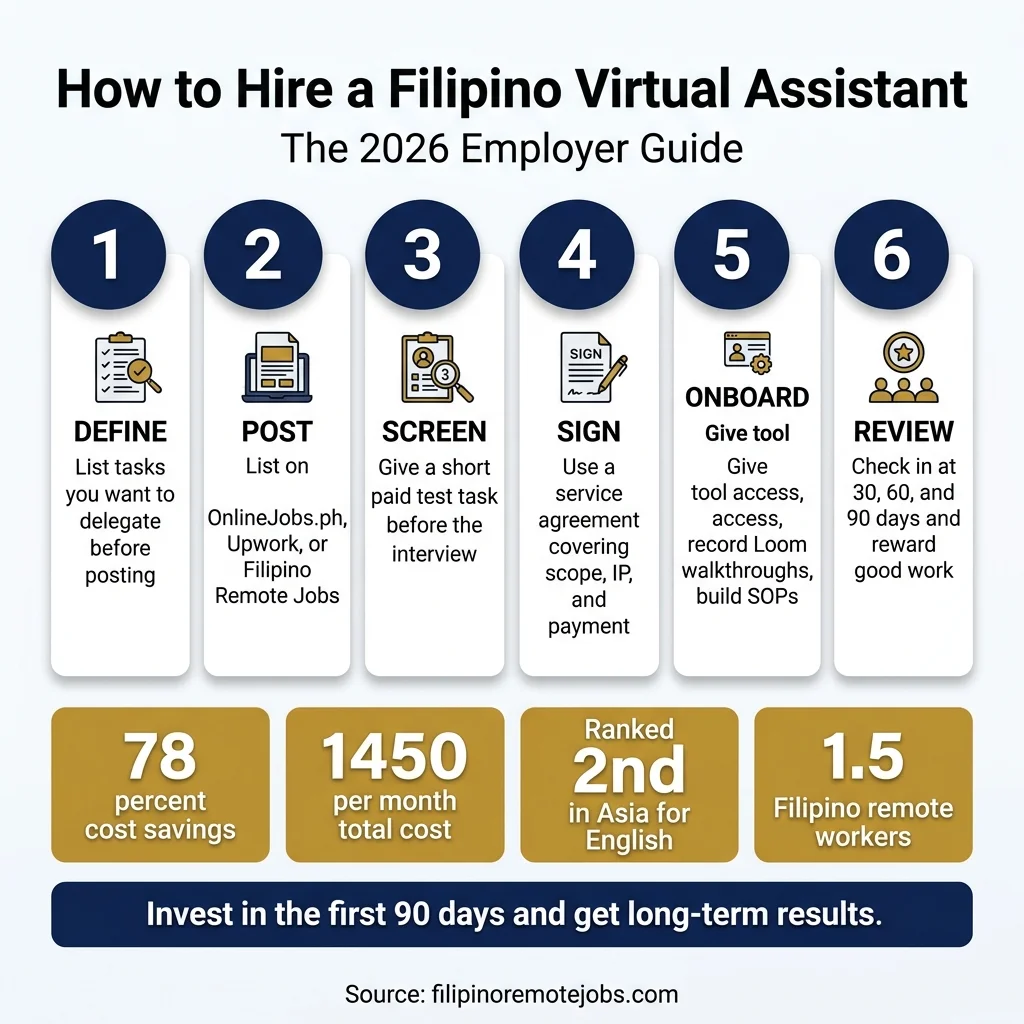
A general admin VA costs $400–$700 per month in the Philippines. The US equivalent — same tasks, same output — starts at $4,000 per month. That 78% cost gap is why thousands of US businesses have turned to Filipino virtual assistants, and why the talent pool keeps growing: over 1.5 million Filipinos currently work for international clients remotely.
But cost alone doesn't explain why employers keep coming back. The Philippines ranks 2nd in Asia and 28th globally for English proficiency (EF English Proficiency Index), and Filipino workers are raised on American media, understand Western business culture, and deliver the kind of communication quality that makes remote delegation actually work.
This guide covers everything a US business owner needs to hire a Filipino VA in 2026: what to pay, where to find qualified candidates, how to screen them, what the legal setup looks like, and how to onboard for long-term success. No fluff, no platform pitches — just a practical walkthrough of the process.
Why hire a Filipino virtual assistant?
The Philippines outperforms other popular outsourcing destinations for VA work for a few specific reasons — and it's worth understanding each before jumping to the how.
English proficiency that holds up in client-facing work
Filipino VAs don't just read English — they write it clearly, understand nuance, and communicate professionally without significant editing. The Philippines has been an English-speaking country since the early 20th century. It's the official language of business and education. This matters for VA roles where you need someone sending emails on your behalf, handling customer support, or managing your professional calendar.
Compare that with other popular outsourcing markets: India offers high-quality English too, but strong regional accent variation can create friction in phone or video-based roles. Eastern European talent delivers strong technical skills but with higher rates and more limited cultural familiarity with US business norms. Latin American VAs offer good time zone alignment but at rates that have risen significantly in recent years.
Filipino VAs hit the intersection of quality communication, cultural alignment, and competitive pricing better than most alternatives.
Cultural compatibility with US businesses
Because of the Philippines' long-standing ties with the United States, Filipino professionals are deeply familiar with American business culture, references, humor, and workplace norms. They understand what a "standup meeting" is, know how to write in American English idioms, and don't need weeks of cultural onboarding before they can communicate naturally with your US customers or partners.
This isn't just anecdotal. Employers consistently cite "communication quality" and "cultural fit" as the top reasons they continue working with Filipino VAs beyond the initial trial period — more so than cost savings alone.
Loyalty and retention
Filipino professionals place significant value on stable, long-term employment. Unlike gig-based platforms where workers jump between clients constantly, Filipino VAs who find a good employer tend to stay. It's common for US businesses to work with the same Filipino VA for 2–5 years.
This matters financially: rehiring, retraining, and re-onboarding is expensive. A loyal VA who knows your systems, your preferences, and your clients is worth more than a lower-cost replacement every few months.
The cost math
Let's put real numbers to it. A skilled Filipino VA at $8/hour, working 40 hours per week, costs $1,280/month. Add a $69 platform fee and roughly $100 in tools and software: you're at around $1,450 total per month.
A US-based admin assistant at $25/hour — the low end for that market — costs $4,333/month in wages alone, before taxes, benefits, and office overhead push that figure well past $60,000 per year.
For a business owner valuing their own time at $50/hour, a $10/hour VA recovering just 75% of delegated tasks generates $4,250/month in net value. That's a substantial return on a modest investment.
What tasks can a Filipino VA handle?
Filipino VAs aren't a monolith — the skillset varies widely by individual. But here's a practical breakdown of what a well-recruited VA can handle from day one, and where you might need to invest in training.
Admin and operations (the core)
This is where most VA relationships start. Admin tasks have clear inputs and outputs, are easy to document, and represent significant time savings for busy owners:
- Email inbox management — sorting, labeling, drafting replies, flagging urgent items
- Calendar scheduling — booking meetings, setting reminders, managing conflicts
- Travel coordination — flights, hotels, logistics for client visits or team travel
- Data entry and CRM updates — keeping HubSpot, Salesforce, or your CRM of choice current
- Document creation and formatting — proposals, reports, slide decks in Google Workspace or PowerPoint
- File organization — standardizing naming conventions, organizing shared drives
Social media management
Filipino VAs are strong in this category, especially for platforms where English content and community management are key:
- Scheduling posts via Buffer, Hootsuite, or Later
- Writing captions and basic copy for Instagram, Facebook, LinkedIn
- Responding to comments and DMs within defined parameters
- Creating simple graphics in Canva for posts and stories
- Monthly analytics reports from native platform tools
Customer support
For US businesses with customer-facing operations, Filipino VAs are frequently used for Tier 1 support:
- Responding to customer emails within defined SLA windows
- Managing Zendesk, Freshdesk, or Intercom ticket queues
- Handling order status inquiries and tracking
- Processing straightforward refund requests and escalating exceptions to you
E-commerce operations
If you're running a Shopify or Amazon store, Filipino VAs with e-commerce experience are abundant and well-trained:
- Product listing creation and optimization (titles, descriptions, keywords)
- Inventory tracking and low-stock alerts
- Supplier communication and order coordination
- Customer review management and follow-up sequences
- Return processing and Seller Central case management
Specialized VA roles (higher pay, specific expertise)
As you go deeper into specific niches, rates go up — but so does the impact:
| Specialization | Typical rate | Tasks |
|---|---|---|
| Real estate VA | $8–$14/hr | CRM (Podio, Follow Up Boss), skip tracing, listing coordination, cold call scripting |
| Bookkeeping VA | $10–$18/hr | QuickBooks/Xero reconciliation, invoice processing, expense tracking |
| Executive assistant | $12–$20/hr | C-suite calendar, confidential tasks, board prep, travel coordination |
| Research VA | $6–$12/hr | Market research, lead list building, competitor analysis, prospect qualification |
| Tech/dev support | $12–$20/hr | Basic website management, WordPress updates, QA testing, Zapier automation |
The right approach: Start by listing everything you did last week that didn't require your specific expertise or judgment. Every task on that list is a candidate for delegation.
What does it cost to hire a Filipino VA in 2026?
Rates vary by experience, specialization, and how you hire. Here's what the market looks like in 2026:
Rate ranges by experience
| Level | Hourly | Monthly (full-time) | Typical tasks |
|---|---|---|---|
| Entry-level (0–1 yr) | $3–$6 | $450–$900 | Data entry, basic admin, social scheduling |
| Mid-level (1–3 yr) | $6–$12 | $900–$1,800 | Social media management, CRM, customer support |
| Senior/Specialized (3+ yr) | $12–$25+ | $1,800–$4,000+ | Bookkeeping, real estate ops, executive support |
Direct hire vs agency — the real cost difference
Direct hire (OnlineJobs.ph, Upwork, Filipino Remote Jobs):
- You pay the VA directly
- No per-hire fee; OnlineJobs.ph charges ~$69/month for platform access
- Cancel the subscription once you've hired — ongoing cost is just the VA's salary
- More management required on your end, but significantly lower monthly cost
Managed agency:
- VirtualStaff.ph, MyOutDesk, 20four7VA, iSuporta, and others handle recruitment, HR, and replacements
- Monthly cost: typically $1,200–$3,000+ depending on role level
- Agency absorbs hiring risk — if the VA doesn't work out, they replace them at no extra cost
- Worth it if you're time-constrained or scaling quickly; adds significant cost markup otherwise
Real cost calculation (direct hire example): A full-time mid-level VA at $8/hour:
- VA salary: $1,280/month
- OnlineJobs.ph Pro: $69/month (cancel after hiring, or $0 ongoing)
- Collaboration tools (Slack, Asana/Trello, Google Workspace): ~$30–$50/month
- Total: ~$1,360–$1,380/month
The US equivalent for the same work: $4,333+/month in wages alone, before taxes and benefits.
Where to find Filipino virtual assistants
OnlineJobs.ph — best for direct hiring
OnlineJobs.ph is the largest platform dedicated entirely to connecting Filipino remote workers with international employers. Over 2 million worker profiles, with thousands of active VA listings at every experience level.
How it works:
- Subscribe to the Pro plan (~$69/month) to unlock messaging and view applicants
- Post a detailed job listing; applications typically arrive within hours for well-written posts
- Review profiles, message candidates, conduct interviews, hire directly
- Cancel your subscription once you've hired — you pay the VA directly, no ongoing platform fee
Best for: Business owners who want to build a long-term direct relationship with their VA and manage them independently.
Upwork — best for flexibility and escrow protection
Upwork gives you access to Filipino VAs in a global marketplace. Rates are typically 15–25% higher than direct hire platforms because Upwork's service fee is built in, but you get escrow protection, dispute resolution, and a time-tracking system.
Best for: First-time hirers who want built-in protections, or project-based work before committing to a long-term arrangement.
VA agencies — best for managed, hands-off hiring
If you want a VA without managing the recruitment and HR process yourself, an agency is the path. You brief the agency on your needs, they recruit and vet candidates, and they provide ongoing support if things don't work out.
Trade-off: Agency pricing is 2–3x direct hire rates. For a $1,500/month mid-level VA hired directly, an agency might charge $2,500–$3,000 for equivalent talent. The premium covers their recruitment infrastructure, quality control, and replacement guarantees.
Filipino Remote Jobs
Filipino Remote Jobs is a curated job board focused specifically on connecting international employers with Filipino remote talent. Post your VA role here to reach candidates who are actively seeking international employment — filtered to the Filipino market specifically.
A note on Facebook Groups
Groups like "Filipino Virtual Assistants" and "VA Jobs Philippines" contain active candidates and job leads. They're worth joining as a supplementary source, but quality control is entirely on you. Not recommended as a primary hiring channel.
How to screen and hire a Filipino VA
The quality of your hire depends almost entirely on your screening process. Here's what works.
Write a job description that filters for quality
Most employers write job posts that are too vague. "Looking for a virtual assistant to help with various tasks" gets you 200 applications from people who have no idea what you actually need.
A good job post includes:
- Specific tools: "Must be proficient in Google Workspace, Trello, and Shopify"
- Specific tasks: "Respond to Zendesk tickets within 2 hours, escalate billing issues to me, handle returns under $50 independently"
- Hours and schedule: "20 hours per week, Monday–Friday, overlap with US Eastern time from 9–11am required"
- Rate range: Being upfront about pay attracts applicants who are actually in your range and signals professionalism
- Small screening task in the post: "To apply, send me a 2-sentence email as if you're responding to an unhappy customer who received the wrong order." People who follow this instruction are showing attention to detail before you've even interviewed them.
The test task filter
Before investing in a full interview, give promising candidates a short paid test task. Keep it to 2–3 hours and pay at your target rate.
Good test tasks:
- "Organize these 50 files in Google Drive according to this naming convention"
- "Draft responses to these 5 customer emails in my voice"
- "Research these 15 competitors and fill in this pricing comparison sheet"
This accomplishes three things: you see actual work quality (not just interview polish), you signal that you're a fair employer worth working for, and you filter for candidates who follow through.
The video interview
After the test task, conduct a 20–30 minute video call. Key questions:
- "Walk me through how you'd handle an inbox with 200 unread emails on your first day." (Tests process thinking, not just enthusiasm)
- "What tools do you use for tracking your tasks across multiple clients?" (Reveals real organization habits)
- "Tell me about the most complex thing you've managed independently for a previous employer." (Surfaces actual experience level)
- "What's your internet situation — backup connection, any regular power interruptions?" (The Philippines question every employer should ask — brownouts and internet instability are real considerations, especially outside Metro Manila)
Red flags to watch for
- Refuses the paid test task: Either overconfident or not serious
- No work samples: Even a new VA should be able to create mock samples to show
- Video performance significantly weaker than written application: May have used AI to write their application
- Inconsistent answers about past experience: Follow up on specifics; vague answers mean vague experience
- "Yes, I can do everything": Over-promising on every skill is a reliable signal of under-delivering on most of them
The legal setup: contractor, taxes, and contracts
Filipino VAs are almost always independent contractors
This is the standard arrangement, and it simplifies things considerably for US employers. As an independent contractor:
- You are not their employer under Philippine law — no obligation to pay Philippine social security (SSS), health insurance (PhilHealth), or housing fund (Pag-IBIG)
- You do not withhold taxes — Filipino contractors are responsible for filing their own taxes with the Bureau of Internal Revenue (BIR)
- No 1099 required — the IRS only requires 1099s for US-based contractors; foreign contractors are exempt
- No payroll registration in the Philippines unless you establish a Philippine legal entity (which is rare for small businesses)
Always use a written service agreement
You don't need a lawyer for this. A 1–2 page service agreement covering these points is standard:
- Scope of work — what tasks they'll perform, hours per week
- Payment terms — amount, currency, payment schedule (weekly or biweekly is typical), method
- IP ownership — all work created for you is work-for-hire and owned by your business
- Confidentiality / NDA — basic protection for client data and business information
- Termination — notice period (2 weeks is standard), conditions for immediate termination
What about employment of record (EOR)?
If you want to hire a Filipino VA as a full legal employee — with Philippine benefits (13th month pay, SSS, PhilHealth, Pag-IBIG) — you'll need an Employer of Record service. Remote.com, Deel, and Multiplier operate in the Philippines.
EOR adds $300–$500/month per worker and makes sense for senior, high-trust roles where you want formal employment to signal commitment and improve retention. For typical VA relationships, contractor arrangements are the norm.
How to pay your VA
- Payoneer — Most popular with Filipino remote workers. Payoneer-to-bank transfers work smoothly in the Philippines. Free for employers to set up; VAs typically pay a small transfer fee.
- Wise — Competitive exchange rates, fast transfers, widely used. Lower fees than PayPal.
- Upwork Payments — Automatic and handled by the platform if you're working through Upwork.
- Bank wire — Works, but high fees on both ends. Not recommended for recurring payments.
Biweekly payment is the most common arrangement for full-time VAs. Weekly payment is also appreciated and increases loyalty.
How to onboard your VA for long-term success
This is where most employers go wrong — and where our guide goes further than most.
Hiring the right person and then not onboarding them properly is like buying good ingredients and burning the meal. The VA can only perform as well as the systems you give them.
Week 1: foundation
- Give full tool access on Day 1. Don't drip access over two weeks. An account waiting for access is a VA who can't do their job.
- Record a Loom video tour. Walk through your email setup, your filing system, your project management tool, and your communication preferences. A 20-minute recording saves hundreds of clarifying questions over the coming months.
- Set up your communication stack. Most employers use Slack for async messaging and Zoom or Google Meet for weekly calls. Set clear expectations: when should they message you vs. handle independently vs. escalate?
- Have them shadow first. For the first few days, have them watch how you handle tasks before taking ownership. Give them read-only access to your email so they can learn your voice before responding on your behalf.
Build SOPs from day one
A Standard Operating Procedure (SOP) doesn't need to be a 10-page document. A Loom recording showing how to do the task + a Google Doc checklist is an SOP. That's it.
Write an SOP for every task you delegate. The process:
- Record yourself doing the task once (Loom)
- Have the VA write out the steps as they watch
- Review their write-up together on a call — their documentation of what they observed
- Use that document as the living SOP, updated as the process evolves
SOPs have two benefits: they reduce errors immediately, and they make the VA genuinely independent over time, which is the goal.
Set communication expectations explicitly
Don't assume your VA knows how much to communicate. Tell them directly:
- Daily async check-in: A brief message each morning — "Yesterday: completed X and Y. Today: starting Z. Blockers: none." Takes 3 minutes, keeps you aligned without a daily call.
- Weekly sync: 30-minute video call for alignment, questions, and feedback. Keep a running agenda document both parties can add to.
- Urgency definition: What counts as urgent enough to interrupt you vs. what goes in the daily update? Define this explicitly.
The 30-60-90 day framework
| Period | Focus | Your involvement |
|---|---|---|
| Days 1–30 | Learning your systems, handling simple tasks with close guidance, SOPs being built | High — daily check-ins, frequent feedback |
| Days 31–60 | Taking ownership of routine tasks, handling exceptions with check-ins | Medium — weekly call, async for most issues |
| Days 61–90 | Working independently, flagging exceptions, suggesting improvements | Low — weekly sync, VA-driven updates |
After 90 days, you should be able to hand off an entire category of work (all inbox management, all social posting, all order processing) and not think about it again.
Compensation review at 90 days
If your VA is performing well at the 90-day mark, a 10–15% pay increase goes a long way. Filipino professionals are not job-hopping — they want long-term stability. Recognizing good work with a raise is far cheaper than the cost of finding, screening, and onboarding a replacement.
The employers who struggle with retention are usually the ones who hired below market, provided no structure, and gave no feedback. The employers with long-term VA relationships are the ones who treat it like any other important working relationship — with respect, clear communication, and reasonable compensation.
Common mistakes when hiring a Filipino VA
Learn from what goes wrong before it happens to you:
1. Hiring without documenting your processes first Your VA can only do what you've shown them how to do. If you can't explain the task clearly, the VA can't do it consistently. Spend one week documenting your 5 most common delegatable tasks before you post a job.
2. Paying below-market rates expecting exceptional talent The talent exists at every price point — but experienced VAs know their worth. Posting $3/hr for a role that requires social media management, customer support, and CRM experience will attract beginners who will need 6 months of training before they're fully productive. Pay your target rate upfront.
3. No test task, no trial period Always conduct a paid test task before hiring. Always structure the first 30 days as a trial period — formalize this in your service agreement. It protects both parties and lets you course-correct early if the fit isn't right.
4. Being too formal or transactional Filipino culture values warm, respectful working relationships. A quick "good morning" at the start of a call, acknowledging personal milestones, and genuinely saying thank you for good work significantly impacts performance and loyalty. This isn't a management philosophy — it's just treating people well, and it's especially valued in Filipino culture.
5. No NDA or service agreement Even for a part-time VA handling admin work, a basic service agreement is essential. IP ownership, confidentiality, and termination terms need to be clear from the start.
6. Micromanaging every task If you're checking in on every email before it gets sent, reviewing every spreadsheet row before it's logged, and approving every social post before it goes live — you've hired a VA to add work to your plate, not remove it. Invest in the SOPs upfront, then let the VA own the execution. Review outputs weekly, not task-by-task.
7. Not asking about their internet and power situation The Philippines has improved significantly in connectivity, but brownouts and occasional service interruptions still happen, particularly outside Metro Manila. Ask about their backup internet plan and UPS setup before hiring. A VA who has invested in a mobile data backup and a small UPS is a VA who has invested in reliability.
Hiring a Filipino VA: the summary
A Filipino virtual assistant can be one of the highest-ROI decisions a small business makes. The combination of strong English communication, cultural alignment, skill breadth, and significant cost savings over local alternatives is hard to find elsewhere.
The formula is straightforward:
- Define the specific tasks you want to delegate before posting
- Post on OnlineJobs.ph, Upwork, or Filipino Remote Jobs
- Screen with a paid test task before committing
- Sign a service agreement covering scope, IP, and payment
- Onboard with tool access, Loom walkthroughs, and clear SOPs
- Review at 30, 60, and 90 days — and reward good performance
The employers who get the most out of this relationship invest in the first 90 days. The ones who struggle treat it like a set-and-forget transaction.
Ready to find your first Filipino VA? Post your job listing on Filipino Remote Jobs and reach qualified candidates who are actively looking for international remote work.
Looking for more on managing your Filipino hire after onboarding? Read our guide on how to onboard a Filipino remote hire in the first 30 days.
Get Remote Jobs in Your Inbox
Join Filipino professionals getting curated remote job opportunities delivered every week. No spam, unsubscribe anytime.
Related Topics
Share this article
About Filipino Remote Jobs Team
The Filipino Remote Jobs Team is dedicated to helping Filipino professionals find legitimate remote work opportunities with international companies. We provide career advice, job search tips, and insights to help you land your dream remote job.
Related Articles
Customer Service Outsourcing to the Philippines: The Complete Employer Guide (2026)
What US/UK/AU employers need to know about customer service outsourcing to the Philippines: real costs, hiring, cultural management, retention, and scaling.
Outsource Web Development to the Philippines: A Practical Guide for Employers
How to outsource web development to the Philippines. Covers costs, engagement models, hiring steps, and management tips for US/UK/AU employers.
The First-Time Employer's Guide to Hiring a Filipino Remote Worker (2026)
A practical, independent guide to hiring your first Filipino remote worker. Covers 2026 salary benchmarks, contractor vs EOR, payments, contracts, and mistakes to avoid.