
Outsource Web Development to the Philippines: A Practical Guide for Employers
How to outsource web development to the Philippines. Covers costs, engagement models, hiring steps, and management tips for US/UK/AU employers.

A mid-level web developer in the US costs $75-125 per hour. In the Philippines, you'll pay $20-35 for equivalent skills. That's a 60-80% reduction in development costs -- and it's the main reason thousands of companies outsource web development to the Philippines every year.
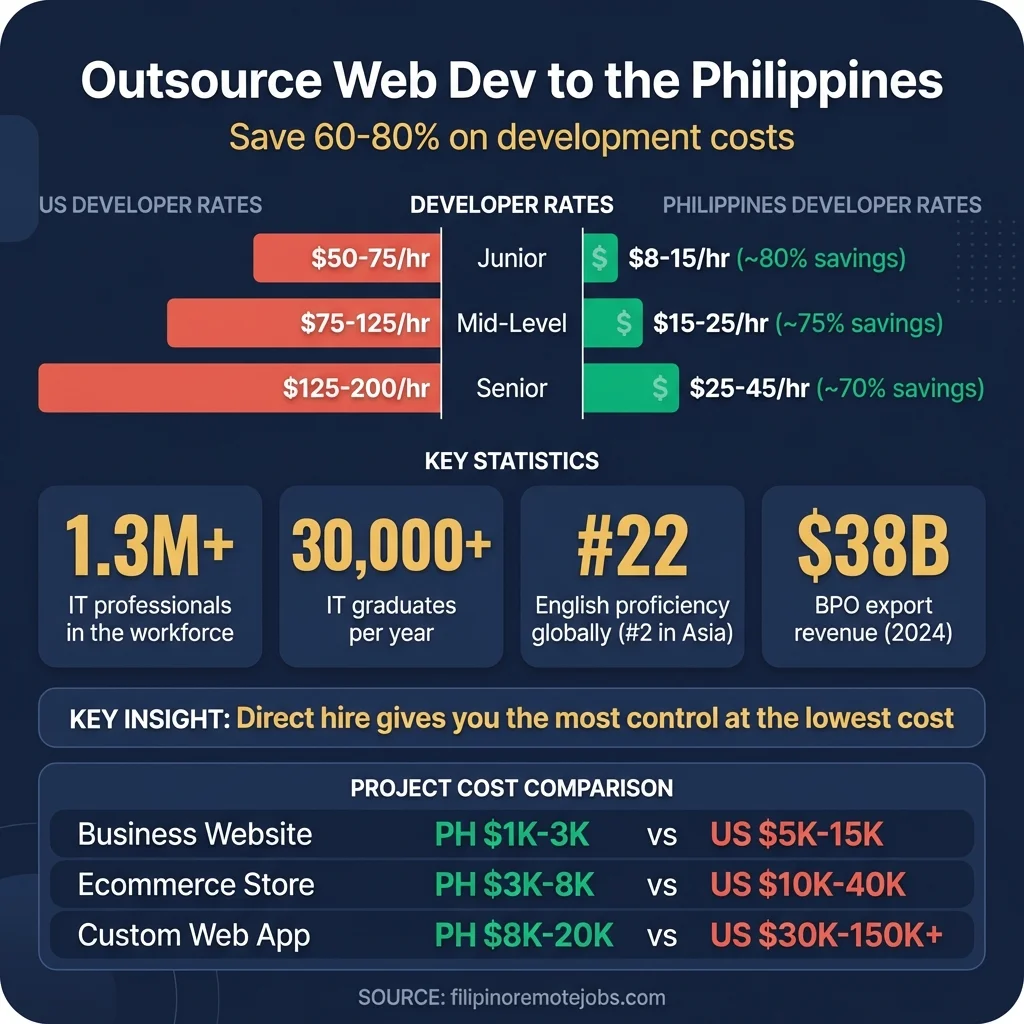
But cost savings alone don't make a good hire. The Philippines also ranks 22nd globally for English proficiency (2nd in Asia, per the EF English Proficiency Index), has an estimated 1.3 million IT professionals in its workforce, and runs a BPO sector that generated $38 billion in export revenues in 2024. This isn't a new or untested market -- Filipino developers have been building for international clients for decades.
This guide covers the practical side: what you can outsource, how to structure the engagement, what to pay, and how to manage the relationship so it actually works.
Why the Philippines for web development
Cost savings without cutting corners
The rate difference holds across all seniority levels:
| Seniority | US Rate | Philippines Rate | Savings |
|---|---|---|---|
| Junior | $50-75/hr | $8-15/hr | ~80% |
| Mid-level | $75-125/hr | $15-25/hr | ~75% |
| Senior | $125-200/hr | $25-45/hr | ~70% |
On a project basis, a business website that runs $5,000-15,000 from a US agency typically costs $1,000-2,700 in the Philippines. A custom web application? $9,000-54,000 versus $30,000-150,000+ stateside.
These aren't bargain-bin rates from junior developers. Filipino devs at the mid and senior level have built production applications for US startups, ecommerce brands, and enterprise companies. One US fintech startup hired a Filipino senior developer who built their entire back end in four months -- saving over $90,000 compared to a local hire.
English proficiency and cultural alignment
The Philippines earned a "High Proficiency" rating on the EF English Proficiency Index, ranking 22nd globally and 2nd in Asia behind Singapore. India, another popular outsourcing destination, ranks 73rd. That gap shows up in daily collaboration -- less time clarifying, more time building.
English is an official language in the Philippines. It's the language of instruction in universities, used in business settings, and all over media. You won't need translators or spend meetings untangling miscommunication.
The education system follows an American model, so Filipino developers are already familiar with Western work practices and client expectations. Cultural friction kills outsourcing relationships faster than technical gaps do, and this is one area where the Philippines has a clear edge.
Deep technical talent pool
The Philippines produces over 30,000 IT graduates per year, and the broader tech workforce includes an estimated 1.3 million IT professionals. The BPO sector alone employs 1.82 million people.
Filipino developers are especially strong in:
- Frontend: React, Vue, Angular
- Backend: Node.js, PHP/Laravel, Python
- CMS/Ecommerce: WordPress, Shopify, WooCommerce
- Mobile: React Native, Flutter
Many are experienced with Agile and Scrum workflows, Git-based collaboration, and the tools remote teams run on (Slack, Jira, Figma).
What you can outsource
Web development outsourcing to the Philippines covers a broad range of work:
- Full-stack development -- Complete applications from frontend to backend
- Frontend builds -- React, Vue, or Angular SPAs and UI implementation
- Backend/API development -- Node.js, Python, PHP/Laravel services
- WordPress and Shopify -- Custom themes, plugins, store builds
- Ecommerce platforms -- WooCommerce, Magento, custom checkout flows
- Maintenance and support -- Bug fixes, updates, performance optimization
What works well remotely: Clearly scoped builds, feature development, bug fixes, and ongoing maintenance. Anything with well-defined requirements translates well to remote collaboration.
What's harder remotely: Discovery-heavy projects where requirements are still forming, rapid prototyping that needs constant whiteboarding, or projects requiring access to proprietary on-site systems. Not impossible -- just plan for more structured communication upfront.
Engagement models: which one fits you
Freelance (project-based)
Best for: One-off projects, tight budgets, quick turnarounds.
You post a job on Upwork, Fiverr, or a specialized job board, find a developer, agree on scope and price, and they deliver.
Pros: Lowest cost, no long-term commitment, fast to start.
Cons: Reliability varies. IP ownership can get murky without a solid contract. If a freelancer disappears mid-project, you're back to square one.
Protect yourself by: Using escrow payments, requiring NDAs upfront, and starting with a small paid test project before committing to larger work.
Direct hire (full-time remote)
Best for: Ongoing development work, team integration, long-term relationships.
You hire a Filipino developer as a full-time remote contractor. They work exclusively for you, join your standups, and become part of your team.
Where to find talent: Filipino Remote Jobs, OnlineJobs.ph, LinkedIn.
Pros: Full control over the developer's time and priorities. Lowest cost per hour of dedicated work. Better retention because they're part of your team, not juggling five clients. Direct communication with no agency in between.
Cons: You handle management, onboarding, and tooling. You need enough work to justify a full-time hire.
This is the model we recommend for most companies. It gives you the best combination of cost, control, and quality. Our employer hiring guide covers the full process.
Outsourcing agency or BPO
Best for: Fast scaling, managed teams, companies that don't want to handle recruitment or HR.
You contract with a Philippine outsourcing company (like CloudStaff, KDCI, MicroSourcing, or Full Scale) that recruits, manages, and provides office space for the developers.
Pros: Fast onboarding, built-in management, office infrastructure with backup power and internet.
Cons: You'll pay a 30-50% premium over direct hire rates for the convenience. Less direct access to your developers. Contracts can be rigid. The agency's priorities don't always match yours.
How to hire the right developer
Define your requirements clearly
Before you post a job or contact an agency, write down:
- Tech stack: Which languages, frameworks, and tools your project uses
- Project scope: What needs to be built, as specifically as possible
- Timeline: When you need delivery (or whether this is ongoing work)
- Working hours: How much timezone overlap you need
Vague requirements are the number one reason outsourcing fails. "Build me a website" gets you garbage. "Build a Next.js marketing site with a headless CMS, these 8 pages, and a contact form integrated with HubSpot" gets you accurate quotes and qualified candidates.
What to look for
- Portfolio or GitHub activity -- Real projects they've shipped, not just tutorials
- Communication skills -- Can they explain technical decisions clearly in English? Do they ask good clarifying questions?
- Timezone availability -- Will they overlap with your working hours for standups and syncs?
- References -- Talk to previous clients if you can
Trial projects and technical tests
A paid trial task (1-2 weeks) is the best way to vet a developer. Give them a small, real piece of work from your project. Pay them fairly for it. You'll learn more from a trial than from any interview or take-home test.
Red flags:
- Can't estimate timelines or won't ask clarifying questions
- Portfolio items that look copy-pasted or don't match their stated experience
- Pushes back on using your communication tools or processes
- Wants full payment upfront with no milestones
Managing your Filipino dev team
Good management separates successful outsourcing from disaster.
Communication: Slack or Teams for daily chat. Loom for complex explanations -- a two-minute video beats a ten-paragraph email. Daily or weekly standups depending on project pace.
Timezone strategy: Most Filipino developers can do 3-4 hours of overlap with US time zones (their morning, your evening, or the reverse). Structure collaboration around those overlap windows. Use async communication -- documented decisions, PR reviews, recorded walkthroughs -- for everything else.
Project management: Use whatever tool you'd use with a local team. Jira, Linear, GitHub Issues, Trello -- pick one and be consistent. Clear tickets with acceptance criteria prevent most miscommunication.
Retention: Filipino developers who feel like real team members stay for years. The ones treated as interchangeable contractors leave. Include them in team channels, acknowledge good work, and invest in their growth. Our onboarding guide covers the first 30 days in detail.
Typical costs
Hourly rates by seniority
| Role | Monthly (Full-Time) | Hourly Equivalent |
|---|---|---|
| Junior developer | $1,300-2,400/mo | $8-15/hr |
| Mid-level developer | $2,400-4,000/mo | $15-25/hr |
| Senior developer | $4,000-7,200/mo | $25-45/hr |
Project-based estimates
| Project Type | Philippines | US Equivalent |
|---|---|---|
| Simple business website | $1,000-2,700 | $5,000-15,000 |
| Ecommerce store (Shopify/WooCommerce) | $2,000-8,000 | $10,000-40,000 |
| Custom web application | $9,000-54,000 | $30,000-150,000+ |
Hidden costs to budget for
Don't forget:
- Tools and licenses -- Slack, GitHub, project management, design tools ($50-200/mo)
- Management time -- Your hours reviewing work, giving feedback, running standups
- Legal -- Contractor agreement and NDA (one-time cost, worth it -- the Philippines has IP protection under RA 8293 and data privacy law under RA 10173)
Infographic: Outsourcing Web Dev to the Philippines at a Glance
Getting started
The Philippines offers the strongest value-for-quality ratio in web development outsourcing right now. The talent pool is deep, English proficiency is high, and the cost savings are substantial.
If you want maximum control at the lowest cost, go with a direct hire. You get a dedicated developer on your schedule, using your tools, integrated into your team -- without an agency markup.
Post a web development job on Filipino Remote Jobs and start getting applications from qualified developers this week.
Get Remote Jobs in Your Inbox
Join Filipino professionals getting curated remote job opportunities delivered every week. No spam, unsubscribe anytime.
Related Topics
Share this article
About Filipino Remote Jobs Team
The Filipino Remote Jobs Team is dedicated to helping Filipino professionals find legitimate remote work opportunities with international companies. We provide career advice, job search tips, and insights to help you land your dream remote job.
Related Articles
The First-Time Employer's Guide to Hiring a Filipino Remote Worker (2026)
A practical, independent guide to hiring your first Filipino remote worker. Covers 2026 salary benchmarks, contractor vs EOR, payments, contracts, and mistakes to avoid.
First 30 Days with Your Filipino Remote Hire: A Week-by-Week Guide
A practical week-by-week guide to onboarding your Filipino remote worker. Learn what to do before Day 1, how to build momentum, and mistakes to avoid.
Online Part-Time Jobs Philippines: 20 Best Options (2026)
Find the best online part-time jobs in the Philippines with salary ranges, skill requirements, and where to apply. From data entry to web development.