
Customer Service Outsourcing to the Philippines: The Complete Employer Guide (2026)
What US/UK/AU employers need to know about customer service outsourcing to the Philippines: real costs, hiring, cultural management, retention, and scaling.

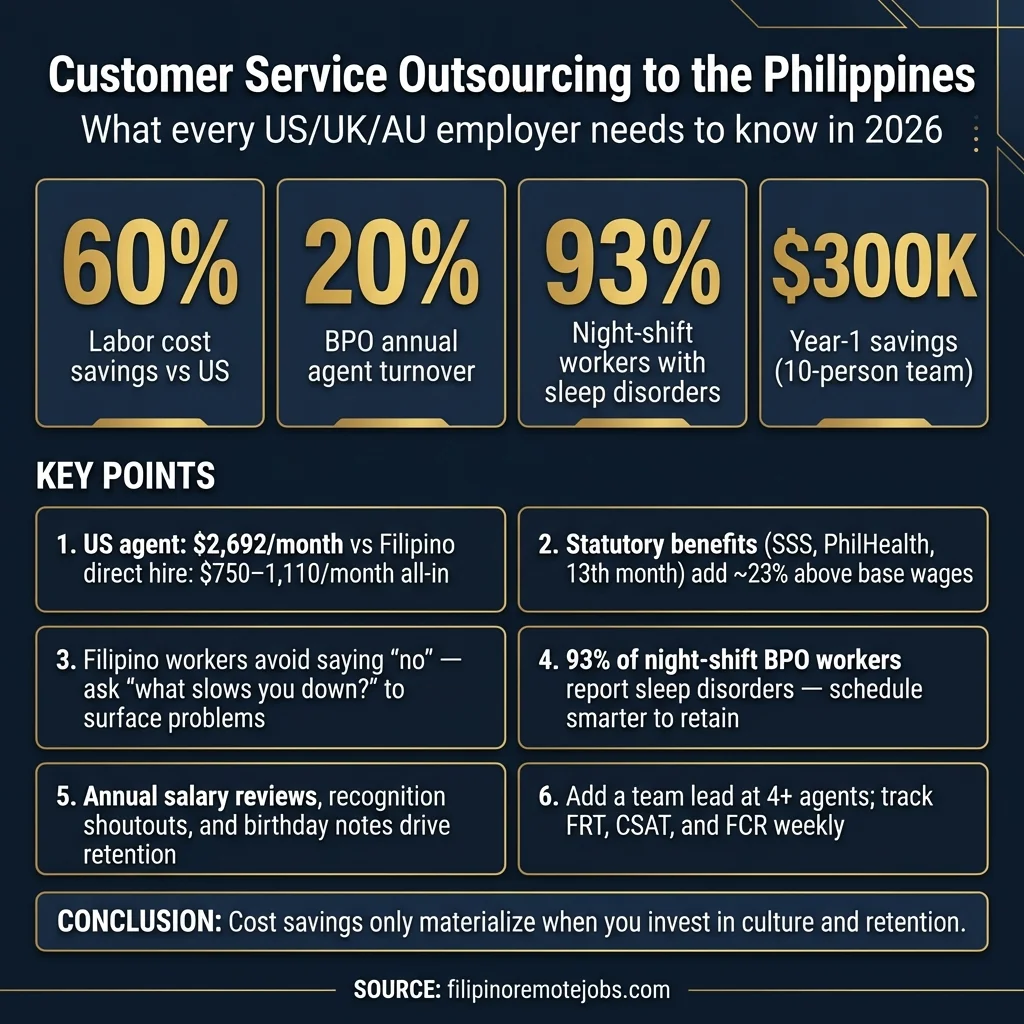
The Philippines has been the world's call center capital for over two decades. The country's IT-BPM sector reached $42 billion in revenue in 2026, employing nearly 2 million Filipinos — and for good reason. When US businesses outsource customer service to the Philippines, they typically save 40–70% on labor costs compared to in-house teams.
But here's what the sales pitch doesn't tell you: BPO industry annual turnover averages 20% — and in some segments, it runs far higher. Employers who hire Filipino CS agents, then manage them the same way they'd manage a US team, routinely discover that their "solved" support problem becomes an ongoing recruiting problem.
This guide covers the full picture. Not just why the Philippines is a great choice — you already know that — but how to hire well, navigate cultural dynamics, retain your team, and scale without losing quality.
Why the Philippines dominates customer service outsourcing
The numbers that matter
The case for the Philippines is well-established:
- English proficiency: The Philippines ranks among the highest in Asia for English fluency. Agents communicate naturally with US, UK, and Australian customers without heavy accent adjustment.
- Scale: 1.97 million Filipinos work in IT-BPM, with 800+ registered outsourcing companies and growing.
- Cost advantage: A customer service agent in the US earns roughly $2,692/month. A comparable Filipino agent (direct hire) earns $600–900/month — plus employer statutory benefits of approximately 23%. Total landed cost: $750–1,110/month.
- Cultural alignment: Decades of US media, education, and business exposure mean Filipino CS agents already understand American consumer expectations. This isn't learned; it's native.
What makes Filipino CS agents effective
Beyond cost, Filipino customer service professionals bring something competitors in other outsourcing destinations often lack: genuine service orientation. The cultural value of kapwa — literally "fellow being" — means treating others with empathy and care is deeply ingrained.
Filipino agents consistently excel at emotionally demanding interactions: frustrated customers, complex complaints, sensitive situations. This resilience and warmth under pressure is one reason the Philippines has held its lead over India and Latin America in voice customer support.
They also adapt quickly. Filipino workers are accustomed to working for clients across multiple time zones, picking up new software fast, and adjusting their communication style to match a brand's tone.
What customer service functions can you outsource?
Customer service outsourcing to the Philippines works across a wide range of functions:
Voice support
Inbound and outbound calls, technical helpdesk, billing inquiries, and customer escalations. Voice works best for complex issues where nuance and empathy matter — high-value customers, sensitive complaints, technical troubleshooting that requires back-and-forth dialogue.
Non-voice support
Live chat, email support, social media moderation, ticket management, and back-office CS operations. Many businesses find that starting with non-voice channels is lower-risk: easier to audit quality, simpler to train, and more forgiving of time-zone gaps.
Specialized functions
- E-commerce: order management, returns processing, tracking inquiries, refund handling
- SaaS: onboarding support, feature education, basic technical troubleshooting
- Healthcare: patient scheduling, insurance queries (HIPAA-compliant providers only)
- Real estate: lead qualification, appointment setting, inquiry handling
Where to start? If you're new to outsourcing CS, begin with non-voice channels and a single function — email support or live chat. Get one agent, get the process right, then expand. Trying to outsource everything at once is how quality problems start.
What does it actually cost? A 2026 breakdown
This is where most outsourcing guides give you a number and move on. Here's a more complete picture.
Direct labor costs
For direct-hire remote agents (not BPO agency):
| Role | Monthly Rate (USD) |
|---|---|
| Entry-level CS agent | $500–900 |
| Experienced agent (2+ years) | $800–1,400 |
| Team lead / QA specialist | $1,000–1,800 |
For the BPO agency model (Metro Manila), entry-level agents run $1,100–1,450/month all-in, with the agency bundling management, compliance, and infrastructure.
Hidden costs employers often miss
Night shift differential: Philippine law requires a 10% pay premium for any hours worked between 10pm and 6am Manila time. If you need US daytime coverage, this applies to your whole team.
13th month pay: Mandatory by law. Every employee receives one additional month's salary, paid by December 24. This is not optional. Budget 8.3% of annual salary per employee.
Statutory contributions: Employer-side contributions to SSS (social security), PhilHealth, and Pag-IBIG (housing fund) add approximately 15% to base salary. Combined with 13th month, total statutory burden is roughly 23% above base wages.
Ramp-up time: Realistically, a new agent needs 4–8 weeks before they're fully productive. During that period, you're paying for training time, quality checks, and corrections. Factor this into your ROI timeline.
BPO agency vs direct hire
| BPO Agency | Direct Hire | |
|---|---|---|
| Monthly cost | Higher (~$1,100–1,450+) | Lower ($750–1,110 all-in) |
| Setup time | Fast (2–4 weeks) | Slower (4–8 weeks) |
| Control | Less (their systems, their management) | More (your systems, your culture) |
| Compliance | Handled by agency | Your responsibility |
| Best for | Teams of 5+, complex operations, compliance-heavy industries | 1–5 agents, long-term direct relationships, brand-immersive roles |
ROI reality check
A US business with a 10-person CS team:
- US in-house cost: ~$500,000/year (salary, benefits, overhead)
- Philippines cost: ~$150,000/year (direct hire, all-in)
- One-time transition cost: ~$50,000 (recruiting, training, tooling)
- Year 1 savings: ~$300,000 (60% reduction)
- Break-even point: 2–3 months
These numbers are consistent with industry benchmarks. The caveat: they assume a well-managed team with reasonable retention. Burn through agents every 8 months and recruiting costs will eat into those savings fast.
Hiring Filipino CS agents: what actually works
Where to find quality candidates
- Filipino Remote Jobs — Post directly to an audience of Filipino remote workers actively looking for international roles
- OnlineJobs.ph — The largest direct-hire platform for Filipino remote workers; strong for VA and CS roles
- VirtualStaff.ph — Curated profiles with background checks
- LinkedIn Philippines — Better for experienced, tech-savvy agents
- BPO agency referrals — If you're hiring a team of 5+, agencies can source at scale faster than job boards
Resume padding reality
AI-enhanced resumes are common. Many candidates submit profiles that overstate experience or list tools they've only used superficially. This isn't unique to the Philippines — it's a global remote hiring problem — but it's worth knowing before you start.
The rule: test, don't trust. Before any offer, require:
- Written English test: A paragraph response to a complex customer complaint (no templates)
- Role-play scenario: How would they handle an angry customer demanding a refund you can't provide?
- Typing speed test: Tools like TypingTest.com — 45+ WPM is the baseline for most CS roles
- Platform check: Have them demonstrate they can navigate your helpdesk tool with a short task
Interview structure that works
- One-way video screen (Loom or HireVue): Ask 3–4 questions, review async. Saves time and lets you assess communication style without scheduling pressure.
- Live role-play call: 20–30 minutes. Give them a realistic scenario from your actual CS queue. How they handle it tells you more than any resume.
- References — call, don't email: Email references are almost always positive and often delayed. Call the previous employer and ask one question: "Would you rehire this person?" The pause before they answer tells you everything.
Contract and compliance basics
Contractor vs employee: Under Philippine law (the "Control Test"), if you dictate when, where, and how a person works, they may qualify as an employee — even if your contract says "contractor." Misclassification carries penalties. When in doubt, use an Employer of Record (EOR) service like Deel, Remote.com, or Multiplier.
Must-have contract clauses for direct-hire contractors: scope of work, payment terms and schedule, confidentiality, IP ownership, termination notice, and dispute resolution. Keep it clear and in English.
The cultural gap nobody talks about
Every outsourcing guide mentions that Filipinos are culturally aligned with Western business. That's true — and also incomplete. Understanding how Filipino culture differs from Western management norms is what separates employers who keep great people from those who can't figure out why agents keep leaving.
Pakikisama: why Filipino employees won't say no
Pakikisama — roughly "going along with the group" or maintaining harmony — is a deeply held Filipino cultural value. In practice, it means your agents will:
- Say "yes, I understand" even when they don't
- Not flag a mistake proactively if it might embarrass them or you
- Avoid telling you that a process is broken
- Not escalate a problem until it's become a crisis
"Pakikisama can sometimes allow problems to go unaddressed in service of preserving harmony, with project delays going unreported because team members are reluctant to report colleague struggles." — GigaBPO, Philippines Work Culture Guide
This isn't dishonesty. It's a deep cultural aversion to conflict and a high value placed on the relationship. When a Filipino employee says "I'll look into that," they may mean "I will absolutely look into that" — or they may mean "I don't want to tell you this is impossible."
How to build a culture where problems surface early
Weekly 1-on-1s with specific prompts: Don't ask "is everything okay?" The answer will always be yes. Ask instead: "What's one thing that slowed you down this week?" or "What would make your job easier?" These questions make problem-surfacing normal and safe.
Anonymous feedback channels: A simple Google Form — shared weekly — where agents can raise issues without attribution. Low tech, high value.
Celebrate problem-reporting: When an agent tells you about a broken process, thank them explicitly. Say out loud that they did the right thing. This gradually shifts the cultural default.
Check comprehension differently: Instead of "Do you understand?", ask "Can you walk me through how you'd handle this?" The gap between thinking they understand and actually understanding only shows when they demonstrate it.
Giving feedback that lands
A 2020 University of the Philippines study found that 54% of Filipino employees were uncomfortable receiving direct criticism from managers. The cultural concept of hiya (roughly: shame or face-saving) means public criticism, blunt assessments, or "you did this wrong" feedback can cause withdrawal, disengagement, or quiet resentment.
This doesn't mean you can't give honest feedback. It means the delivery matters more than you're probably used to.
A framework that works:
- Start with what they did well (genuine, specific)
- Describe the behavior and its impact: "When X happens, Y result follows"
- Ask for their perspective: "What do you think happened there?"
- Agree on the forward path together
Always give substantive feedback privately. Never in front of other team members.
Communication style adjustments that help
- Over-communicate instructions: Ambiguity defaults to "yes, understood" even when it isn't. If a process has steps, write them out explicitly. Don't assume context carries over from a quick Slack message.
- Use Loom instead of written SOPs for new processes: Watching something done is easier to follow than reading instructions, especially when English isn't someone's first language.
- Async check-ins beat open-ended questions: "Here are 3 things from today's queue — how would you handle each?" gets more useful signal than "Any questions?"
Retention: the problem every employer discovers too late
The attrition reality
The Philippine BPO industry averaged 20% annual attrition in 2023. For direct-hire remote workers who are managed well, retention is substantially better — but it still requires active effort. The Department of Labor and Employment has cited work-related stress and night shift lifestyle disease as the main drivers of BPO attrition.
What this costs you: replacing one agent typically runs 1–2 months of their salary when you factor in recruiting time, hiring fees, training hours, and the ramp-up period before the new agent is productive. A team of 5 agents with 40% annual attrition means replacing 2 agents per year — a real drag on your cost savings.
What makes Filipino CS agents stay
The top retention drivers aren't mysterious: stability, respect, growth, and fair pay. But there's a Filipino-specific dynamic worth knowing.
BPO companies recruit aggressively. A BPO firm in Manila will call your direct-hire remote agent and offer PHP 2,000 more per month (roughly $35). For someone earning PHP 30,000/month, that's a 7% raise — often enough to trigger a move. The BPO can afford this because their own attrition model assumes agents won't stay long anyway.
Your advantage as a direct employer: flexibility, a personal relationship, less bureaucracy, and a work arrangement most BPOs can't match.
Retention strategies that actually work
13th month + performance bonus: The 13th month is legally required, but many direct-hire employers treat it as optional. It isn't, legally or culturally. Budget for it from day one. A small performance bonus on top signals that you see and value their work.
Annual salary review: Even a 5–10% annual increase matters at Filipino wage levels. An agent earning $700/month who gets a $50 raise feels seen. One who gets nothing for two years is halfway out the door.
Skills development budget: Even $50–100/year for an online course is meaningful. Offer it. Point them toward something specific to their role — Zendesk certification, Google Analytics, a writing course. It signals long-term investment.
Recognition: Filipinos value acknowledgment deeply. A specific shoutout — "Maria handled 47 tickets this week and got a 98% CSAT — incredible work" — in a team meeting or Slack channel costs nothing and lands better than most bonuses.
Birthday and work anniversary acknowledgment: This sounds minor to Western employers; it isn't. A message and a small gift card ($10–25) on their birthday, a personal note on their work anniversary. It takes 5 minutes and is remembered for years.
Schedule flexibility: When possible, accommodate requests around family events. Filipino family culture is close-knit. An employer who lets an agent attend a family event without burning vacation time earns loyalty that money can't replicate.
When quality drops before they leave
Filipino employees rarely give dramatic notice. What typically happens: quality quietly declines over 4–8 weeks before a sudden resignation. The pattern is common enough that it's worth watching for.
If an agent's CSAT drops unexpectedly or they're missing more deadlines, don't wait for the quarterly review. Have the conversation directly: "I've noticed things have been harder lately. Are you still happy here? Is there anything I can do differently?" Most of the time, they'll tell you. Some of the time, you can fix it.
Managing time zones and night shift responsibly
The night shift trap
Most US businesses want customer service coverage during US business hours — say, 9am–5pm EST. In Manila, that's 10pm–6am. Philippine law requires a 10% night differential for those hours.
More importantly: research on Philippine BPO workers found that 93% report sleep disorders and 96% report chronic musculoskeletal problems. Night shift work is linked to higher burnout, depression, and long-term health issues. The DOLE has identified graveyard shift conditions as a primary driver of BPO attrition.
Here's the practical math: agents who work sustained night shifts burn out faster, get sick more often, and leave sooner. A team that turns over every 12–18 months is more expensive than the 10% night shift premium you'd pay for smarter scheduling.
Smarter scheduling options
Split coverage model: Hire one agent for PH morning shift (covering US evening/overnight tickets, mostly email) and one for PH afternoon shift (covering peak US business hours). Neither works a full graveyard shift; you get near-24/7 coverage.
Async-first for off-hours: For tickets outside your coverage window, use a ticketing system with a committed response SLA — say, 12 hours — rather than live coverage. Most customers accept this for non-urgent issues.
Rotating shifts with rest windows: If night coverage is essential, rotate it. No agent should be on permanent graveyard. Build in guaranteed daytime windows each week.
Hybrid: live for peaks, async off-hours: Identify your actual peak hours (often 10am–2pm and 2pm–6pm US time). Prioritize live coverage there. Let async handle the rest.
Tools that reduce real-time dependency
- Zendesk, Freshdesk, Gorgias (for ecommerce): ticketing with SLA tracking, canned responses, and team handoffs
- Loom: async video walkthroughs cut down on sync meetings
- AI first-response tools: Modern helpdesk AI can handle 60–70% of common inquiries before human review — reducing volume so agents focus on the cases that actually need them
Scaling beyond one agent: building a CS team
When you're ready to scale
Signs your single-agent model has hit its limit:
- First response times are slipping past your SLA
- CSAT scores are declining
- Your agent is working extra hours to keep up
- Tickets are sitting unresolved for days
A natural growth path: 1 agent → 2–3 agents → 5–8 agents → 10+ with a team lead structure. Don't skip stages. The jump from 2 to 8 agents without a team lead usually creates quality problems.
Team structure options
Generalist team: All agents handle all channels. Simpler to manage, more flexible staffing. Best for teams under 5 agents.
Specialist teams: Separate agents for voice, live chat, email, and social. Higher quality per channel, more management overhead. Best for 8+ agents.
Team lead model: One senior agent manages 4–6 junior agents — handling escalations, running quality reviews, and acting as your management layer on the ground. Add a team lead when you hit 4+ agents. The investment pays back quickly.
Quality assurance at scale
5 metrics every CS team should track:
- First Response Time (FRT)
- Resolution Time (average)
- Customer Satisfaction Score (CSAT, from post-resolution surveys)
- First Contact Resolution Rate (FCR)
- Ticket backlog size
Weekly QA spot checks: Review 10% of closed tickets per agent. Check for tone, accuracy, resolution quality, and SOP compliance. Give feedback within 24 hours.
Knowledge base: Build a shared, searchable knowledge base as your primary quality tool. Every policy decision, common scenario, and edge case your agents encounter should be documented there. An agent who can look up the answer in 30 seconds handles the ticket faster and more accurately than one who guesses.
Building team culture at scale
Weekly team meeting (30 minutes): Share wins, flag process issues, review a tricky ticket together. Consistency matters more than format.
Peer recognition: A simple Slack channel where agents can tag each other for good work builds team cohesion faster than any manager-driven program.
Career path: Create a visible progression — Agent → Senior Agent → Team Lead → Quality Analyst. Even in a small team, named levels with clear criteria give people something to work toward. Agents who see a future with you stay longer.
Building a team that sticks
The savings from customer service outsourcing to the Philippines are real — but they depend on building a team, not just filling seats. The employers who get the most value are the ones who invest in communication, adapt their management style, pay fairly, and treat retention as a deliberate strategy.
The talent is there. So is the infrastructure. What makes the difference between outsourcing that works long-term and outsourcing that constantly churns is how you manage once you've hired.
Ready to find your next customer service hire? Post a job on Filipino Remote Jobs to reach Filipino remote workers actively looking for international opportunities. Or explore our employer resources to learn more about building your remote team.
Looking for more guidance on your first hire? Read our complete first-time employer guide, or get a week-by-week plan for the first 30 days with your new hire.
Get Remote Jobs in Your Inbox
Join Filipino professionals getting curated remote job opportunities delivered every week. No spam, unsubscribe anytime.
Related Topics
Share this article
About Filipino Remote Jobs Team
The Filipino Remote Jobs Team is dedicated to helping Filipino professionals find legitimate remote work opportunities with international companies. We provide career advice, job search tips, and insights to help you land your dream remote job.
Related Articles
Outsource Web Development to the Philippines: A Practical Guide for Employers
How to outsource web development to the Philippines. Covers costs, engagement models, hiring steps, and management tips for US/UK/AU employers.
The First-Time Employer's Guide to Hiring a Filipino Remote Worker (2026)
A practical, independent guide to hiring your first Filipino remote worker. Covers 2026 salary benchmarks, contractor vs EOR, payments, contracts, and mistakes to avoid.
First 30 Days with Your Filipino Remote Hire: A Week-by-Week Guide
A practical week-by-week guide to onboarding your Filipino remote worker. Learn what to do before Day 1, how to build momentum, and mistakes to avoid.