
The Philippine BPO Industry Is Dying: An Honest Guide for Filipino Workers Who Refuse to Go Down With It
AI is replacing BPO jobs faster than expected. The data Philippine call center workers need, the roles that are safe, and your 90-day plan to pivot.

Last month, a team leader at a major Makati BPO site gathered her 40-person team into a conference room. No one was on the floor taking calls. The IVR handled everything now. She told them their campaign was ending -- not because the client left, but because the client's AI system had gotten good enough to handle 80% of the volume alone. Twenty-eight of them would be "released" by end of month. The remaining twelve would stay on to manage escalations the AI couldn't resolve.
Twelve people doing what forty used to do.
If that sounds dramatic, consider Klarna. The Swedish fintech company replaced 700 customer service agents with an AI chatbot in 2024, projected $40 million in annual savings, and publicly celebrated the move. Then customer satisfaction tanked. The CEO admitted "we went too far" and started rehiring humans.
That reversal tells you everything you need to know about the next decade. The future of BPO isn't AI replacing humans. It's messier, scarier, and more opportunity-filled than that.
If you're one of the 1.9 million Filipinos in the IT-BPM industry, this isn't hypothetical. This is your career. Your rent. Your family's stability. And the version of BPO that employed millions of Filipinos at scale -- rows of agents reading scripts, handling simple queries, clocking adherence scores -- is ending.
What's replacing it is a different kind of work entirely. And the workers who understand this transformation will come out of it earning more, not less.
But you need to start moving now.
The evidence -- what's already happening
Here's what the Philippine BPO industry actually looks like right now, because the numbers are both impressive and terrifying.
The IT-BPM sector generated $40 billion in revenue in 2025. It employs 1.9 million workers directly. It accounts for roughly 8-9% of the Philippines' GDP -- comparable to the $39.62 billion in personal remittances that OFWs sent home in 2025. BPO isn't just an industry in the Philippines. It's a pillar of the economy.
But here's the stat that should keep you up at night: 83% of Philippine BPO revenue comes from contact center services. Not software development. Not data analytics. Not AI consulting. Voice and chat support. The exact category of work that AI is targeting first and hardest.
That's not diversification. That's concentration risk at a national scale.
The AI invasion is already underway
This isn't a future scenario. According to the ASEAN+3 Macroeconomic Research Office (AMRO), 67% of IT-BPM companies in the Philippines have already adopted AI tools. Two-thirds of the industry is already integrating the technology that threatens its workforce.
The global numbers are even more sobering:
Gartner projected in 2022 that conversational AI will reduce contact center labor costs by $80 billion by 2026. Not revenue. Labor costs. That's a polite way of saying "the money currently being paid to human agents."
In a March 2025 report, Gartner went further: by 2029, agentic AI will resolve 80% of common customer service issues autonomously -- without any human involvement. Not "assist with." Resolve. On its own.
The International Monetary Fund weighed in with a February 2025 report finding that one-third of all Philippine occupations are highly exposed to AI displacement. The International Labour Organization (ILO) flagged the BPO sector specifically in its 2016 "ASEAN in Transformation" report: 89% of the BPO workforce is at high risk of automation.
Eighty-nine percent.
The economics are brutal
Companies aren't adopting AI because it's trendy. They're adopting it because the math is undeniable.
AI cost per customer interaction: $0.50-$5. Human agent cost per interaction: $5-$25.
That's a 5-10x cost difference. For a company handling millions of interactions per month, that's not an optimization. That's an existential choice. No CFO in the world is going to ignore those numbers.
And the real-world case studies are already piling up:
Dukaan, an Indian e-commerce platform, replaced 90% of its customer support staff with AI in 2023. Resolution time dropped from over 2 hours to about 3 minutes. Costs fell by 85%. The CEO didn't sugarcoat it: the AI simply performed better.
Teleperformance, one of the world's largest BPO companies -- and a major employer in the Philippines -- invested $13 million in Sanas, an AI startup that neutralizes accents in real-time. Think about what that means: one of the BPO industry's selling points for Filipino workers has been the neutral accent and American English proficiency. Now AI can give anyone a neutral accent instantly.
Why "this time is different" isn't just a cliche
Every technology wave brings "this time is different" claims. Usually, they're wrong. But there's a real argument for why AI and BPO is genuinely different from, say, the internet and manufacturing.
Previous automation replaced repetitive physical tasks. AI replaces repetitive cognitive tasks -- the exact kind of work that makes up most BPO operations.
AI doesn't just do the job cheaper. It does it in real-time, 24/7, in any language, without training time, without breaks, without adherence scores, without attrition. It doesn't call in sick. It doesn't need two weeks of nesting. It handles 10,000 simultaneous conversations without blinking.
The counter-argument used to be "but AI can't handle complex emotions and nuance." That was true in 2023. It's less true every quarter.
But here's what the headlines get wrong
If you stopped reading at the last section, you'd think every BPO worker should panic, pack up, and retrain as a programmer immediately.
Don't.
Because the data also tells a more nuanced story -- and that nuance is where your opportunity lives.
Gartner, September 2025: 0% of Fortune 500 companies will fully eliminate human customer service by 2028. Zero. Not one of the world's largest companies plans to go fully AI for customer interactions within the next two years.
Gartner, December 2025: Only 20% of customer service leaders actually reduced headcount as a result of AI adoption. Despite all the hype, 80% of companies that adopted AI kept their human teams intact or even grew them.
Gartner, February 2026: 50% of companies that cut customer service staff will rehire by 2027. Half the companies that did lay people off are expected to reverse course within a year or two.
And across the industry: 95% of customer service leaders plan to retain human agents alongside AI, and 75% of customers still prefer human agents for complex or sensitive issues.
Klarna's story is the proof. They went all-in on AI, saved money, and then watched customer satisfaction crater. The AI could handle the volume. It couldn't handle the empathy, the judgment calls, the "let me talk to a real person" moments that define whether a customer stays or churns.
The real future: AI + human, not AI vs. human
The future isn't a world where AI replaces all BPO workers. It's a world where AI handles the simple, repetitive, high-volume tasks -- and humans handle everything that requires judgment, creativity, emotional intelligence, and complex problem-solving.
But here's the critical part that most people miss: this means different jobs, not the same jobs.
The call center agent reading a script to walk someone through a password reset? That job is going away. The customer success specialist who uses AI to instantly pull up a customer's full history and then applies human judgment to resolve a complex billing dispute? That job is growing.
Same industry. Completely different role. And the gap between those two roles -- in pay, in security, in career trajectory -- is widening every month.
Which BPO roles are safe (and which aren't)
Not all BPO roles face the same level of risk. Here's an honest assessment.
High risk -- being automated NOW
These roles are actively being replaced by AI across the global BPO industry:
- Basic voice support (Level 1): FAQ handling, password resets, account balance checks, simple troubleshooting. AI chatbots and voice bots handle these faster and cheaper than humans.
- Simple email and chat support: Routine queries, order status updates, return processing, basic product questions. AI resolves these with near-perfect accuracy.
- Data entry and basic transcription: AI-powered OCR and speech-to-text tools have made manual data entry largely obsolete for straightforward tasks.
- Basic content moderation: Clear-cut policy violations (spam, obvious hate speech, explicit content) are increasingly flagged by AI with minimal human review.
If your daily work consists primarily of these tasks, you're in the danger zone. Not in five years. Now.
Medium risk -- changing fast
These roles still need humans, but the job is transforming:
- Technical support (Level 1): AI is handling more first-line technical troubleshooting. Humans are becoming escalation points rather than first responders.
- Back-office processing: Invoice processing, claims handling, and basic accounting tasks are being increasingly automated. The human role is shifting to exception handling and quality control.
- Nuanced content moderation: Cases involving context, cultural sensitivity, or ambiguous policy interpretation still need human judgment -- but the volume of work requiring humans is shrinking as AI improves.
Lower risk -- AI augments, doesn't replace
These roles are actually becoming more valuable as AI handles the grunt work:
- Complex problem-solving: Billing disputes, service recovery, multi-issue resolution. These require empathy, negotiation, and creative thinking that AI can't replicate.
- Client relationship management: Building and maintaining relationships with key accounts. Trust, rapport, and strategic thinking are irreplaceable.
- AI training and quality assurance: Someone needs to train the AI, monitor its outputs, catch its mistakes, and improve its performance. This is a growing category.
- Specialized industry knowledge: Healthcare support requiring HIPAA compliance, legal process outsourcing, financial services with regulatory requirements. Domain expertise plus compliance requirements create a moat against automation.
- Creative and strategic roles: Content strategy, campaign management, brand voice development. AI can execute; humans strategize.
The question isn't whether your job will be affected by AI. It's whether you'll be the person AI replaces or the person who uses AI to do better work.
Why Filipino workers actually have an edge
Here's where the narrative shifts -- and where you should start feeling cautiously optimistic instead of purely terrified.
Because despite everything I've laid out, Filipino workers are actually better positioned for the AI transition than most people realize.
You're already using AI
The Philippines ranks 6th globally in ChatGPT adoption, with 42.4% of internet users having used the tool, according to the Digital 2026 report by Meltwater and We Are Social. In terms of raw traffic, the Philippines is 4th globally for ChatGPT visits -- 94.38 million monthly visits as of early 2024. Filipinos aren't AI-resistant. They're AI-enthusiastic.
Your English is a superpower
The 2025 EF English Proficiency Index ranks the Philippines 28th out of 123 countries globally and 2nd in Asia for English proficiency. In the AI + human hybrid model, where AI handles volume and humans handle complexity, English fluency and cultural compatibility with Western clients become more valuable, not less. AI can translate languages, but it can't replicate the natural, American-accented English conversation that Filipino workers deliver.
You're young enough to adapt
The Philippines has a median age of about 26 years and a 67.1% working-age population. That means decades of productive career ahead to learn new skills, pivot to new roles, and grow with the industry rather than being left behind by it.
The hybrid model favors you
The emerging AI + human model is essentially this: AI brings the speed, the data processing, the 24/7 availability. Humans bring the empathy, the cultural fit, the judgment, the relationship skills.
Filipino workers bring all of the human side -- strong English, service-oriented culture, American cultural fluency, professional communication skills -- and they're already demonstrating AI fluency on top of it.
The Tony Blair Institute projects that AI will contribute PHP 2.8 trillion to the Philippine economy by 2030. That's not money that replaces Filipino workers. That's money that flows through new roles, new services, and new industries that need Filipino talent.
Filipino workers who add AI fluency to their existing skillset don't become less valuable. They become the most competitive remote workforce in the world. The combination of English proficiency, cultural compatibility, cost-effectiveness, AND AI capability is a package that very few countries can match.
Your 90-day adaptation plan
Enough theory. Here's exactly what to do, starting today.
Days 1-30: Assess and upskill
Week 1: Honest self-assessment
Go back to the risk tiers in the previous section. Where does your current role fall? Be brutally honest. If 70% of your daily tasks are in the "high risk" category, you need to move faster than someone in the "medium risk" zone.
Write down every skill you use at work -- not just the ones on your job description. Include soft skills like conflict resolution, English communication, multitasking, CRM expertise. These are transferable assets.
Weeks 2-4: Start learning
The good news: upskilling doesn't have to cost you anything.
TESDA offers 150+ free online courses, including programs in AI and data science. These are government-backed, recognized by Philippine employers, and completely free. Start here.
Google Career Certificates cover Cybersecurity, Data Analytics, Digital Marketing, IT Support, Project Management, and UX Design. Over 6,000 Filipinos have graduated, and 80% report a positive professional impact. These certificates are globally recognized and affordable.
If you're not sure which certifications to prioritize, we put together a detailed breakdown of free certifications that actually help you get hired remotely. It covers which ones employers actually care about versus which ones just look good on paper.
For a broader view of what skills the market is rewarding right now, check out our guide to the most in-demand skills for Filipino remote workers.
What to focus on:
- AI fundamentals (what AI can and can't do, basic prompt engineering)
- Data literacy (reading dashboards, basic analytics)
- One specialized skill aligned with your target role (see the next section on roles to move into)
Days 31-60: Build AI fluency
This is where you go from "I've heard of ChatGPT" to "I use AI tools to deliver better results."
Learn the AI tools used in your industry. If you're in customer service, that means understanding AI chatbot platforms, sentiment analysis tools, and automated ticketing systems. If you're in back-office processing, it means learning about AI-powered document processing and workflow automation.
Practice AI-augmented workflows every single day. Use ChatGPT or Claude for email drafting, ticket summarization, and data analysis. Use Grammarly for every piece of written communication. Use Canva AI for visual content. We have a full guide on AI tools for Filipino remote workers that covers exactly which tools to use and how.
Build a "before and after" portfolio. This is your secret weapon. Document specific tasks you currently do manually, then show how you do them faster and better with AI assistance. For example:
- "Manual email response: 15 minutes. AI-assisted email response: 4 minutes. Same quality, personalized."
- "Manual report generation: 2 hours. AI-assisted report generation: 30 minutes. More comprehensive."
This portfolio proves to future employers that you're not just aware of AI -- you know how to use it to deliver measurable results.
Days 61-90: Pivot or level up
Update your online presence. Your LinkedIn profile should showcase AI skills prominently. Don't just list "ChatGPT" in your skills section. Describe what you've accomplished with AI tools. Our guide on LinkedIn profile optimization for Filipino remote workers walks you through exactly how to position yourself for the AI-augmented job market.
Apply to AI-resilient roles. Use the list in the next section as your target. Focus on roles that combine your existing BPO experience with AI fluency -- this is where competition is lowest and demand is highest.
Negotiate with your current employer. If you want to stay in BPO, push for an AI-augmented role or company-sponsored training. Present it as a win for them: "I can handle 3x the volume if you train me on your AI tools." Most employers prefer upskilling existing staff over hiring new people. If you need help with the salary conversation, read our guide on how to negotiate your remote salary.
Consider the non-voice pivot. If your current role is firmly in the "high risk" category, it might be time to move to non-voice remote work entirely. BPO experience is a massive advantage in roles like virtual assistance, project management, and customer success. We wrote a complete playbook on how to escape call center work and transition to non-voice remote jobs.
The roles Filipinos should be moving into
Here are the specific roles where demand is growing, AI exposure is low, and Filipino workers have a natural advantage.
AI prompt engineer / AI trainer
Demand surge: 135.8% increase in job postings in 2025, according to Autodesk's AI Jobs Report. Global salaries range from $95,000 to $270,000. The Philippine equivalent sits around PHP 60,000-100,000+ per month for remote roles with international companies.
This is the role that didn't exist three years ago. Companies need humans to train, fine-tune, and quality-check AI outputs. If you understand how AI thinks -- its strengths, its failure modes, its biases -- you're qualified for work that pays 3-5x what a call center agent earns.
Your BPO advantage: you've spent years dealing with the exact types of customer interactions that AI is trying to learn. You know what good support looks like. That domain knowledge is invaluable for training AI systems.
Customer success manager
The customer success management market is growing from $2.45 billion to $9.74 billion by 2032 -- a 21.8% compound annual growth rate. This role is relationship-driven, empathy-heavy, and strategic. It's exactly what AI can't do.
Customer success managers don't answer tickets. They manage portfolios of clients, ensure long-term satisfaction, identify upsell opportunities, and prevent churn. AI handles the transactional support; you handle the human relationship.
Your BPO advantage: years of customer-facing experience, understanding of service metrics, and the ability to handle difficult conversations.
Digital marketing specialist
AI handles the execution -- scheduling posts, generating ad copy variations, analyzing basic metrics. Humans handle the strategy -- understanding audiences, crafting brand voice, making creative decisions. Marketing job postings continue to grow year over year, driven by the digital transformation every industry is going through.
Your BPO advantage: understanding of Western audiences, English proficiency for content creation, and experience with data-driven performance metrics.
Healthcare / legal / finance virtual assistant
Senior VAs in specialized industries earn PHP 40,000-80,000+ per month. These roles require deep industry knowledge, compliance awareness (HIPAA, GDPR, financial regulations), and the ability to handle sensitive information with discretion.
These are hard to automate precisely because they require specialized judgment. AI can draft a generic email, but it can't handle the specifics of a healthcare provider's compliance requirements.
Your BPO advantage: if you've worked on healthcare, legal, or financial accounts in BPO, you already have domain knowledge that takes years to build.
AI operations / AI quality assurance
According to Gartner, 42% of organizations are actively hiring AI strategists, conversational AI designers, and automation analysts. These roles sit at the intersection of AI technology and business operations -- ensuring AI systems work correctly, improving their performance, and managing the human-AI workflow.
Your BPO advantage: you understand the operational workflows that AI is being inserted into. Quality assurance in BPO translates directly to quality assurance for AI systems.
The salary impact
According to research cited by PIDS and the Philippine Tribune, AI skills boost salaries by up to 47% globally. That's not a minor bump. That's the difference between PHP 25,000/month and PHP 37,000/month. Or between PHP 60,000/month and PHP 88,000/month.
The investment in AI skills has a measurable, significant return.
The window is open, but closing
The Philippine government knows what's coming. The National AI Strategy (NAISR 2.0) is in place. The Digital Workforce Competitiveness Act is moving through legislation. The "Trabaho Para sa Bayan" 10-year plan explicitly addresses AI-driven workforce transformation.
According to the World Economic Forum's Future of Jobs Report 2025, 77% of employers plan to reskill employees for AI collaboration between 2025 and 2030. That's encouraging -- but there's a critical difference between being reskilled by your employer and reskilling yourself.
The workers who wait for their company to train them will be the last to adapt. They'll get the basic training, compete with every other worker who got the same basic training, and fight over a shrinking pool of traditional roles.
The workers who start now -- who build AI fluency on their own, who develop a portfolio of AI-augmented work, who position themselves for the roles listed above -- will be the ones employers fight to hire.
This is not a drill
The BPO industry isn't dying. That headline is intentionally provocative. What's dying is the version of BPO that employed 1.9 million Filipinos doing the same types of tasks that AI now handles better and cheaper.
What's emerging is a different industry. One where AI handles volume and humans handle value. Where Filipino workers are still essential -- but for different reasons. Not because they can read a script at 3 AM. Because they can do what AI can't: think critically, build relationships, exercise judgment, and communicate with the emotional intelligence that keeps customers loyal.
The transformation is happening. The question is whether you transform with it or wait until you're forced to.
What to do right now
If you're still in BPO: Start your 90-day plan today. Not Monday. Not next month. Today. Audit your skills, sign up for one free course, and spend 30 minutes exploring AI tools tonight.
If you're already looking for remote work: Prioritize roles from the list above. Position your BPO experience as an asset, not something you're escaping from. Build AI fluency into every application and portfolio piece.
If you're an employer: The Filipino workforce is adapting faster than most give them credit for. The country's AI adoption rates, English proficiency, and young demographics make it one of the best talent markets for the AI + human hybrid model.
Browse remote jobs on Filipino Remote Jobs that value human skills -- critical thinking, relationship management, and creative problem-solving. Or create a free account to get matched with roles where your BPO experience and AI fluency make you the ideal candidate.
The floor is shifting. But you've already survived graveyard shifts, impossible AHT targets, and irate customers at 4 AM. You can handle this too.
You just need to start.
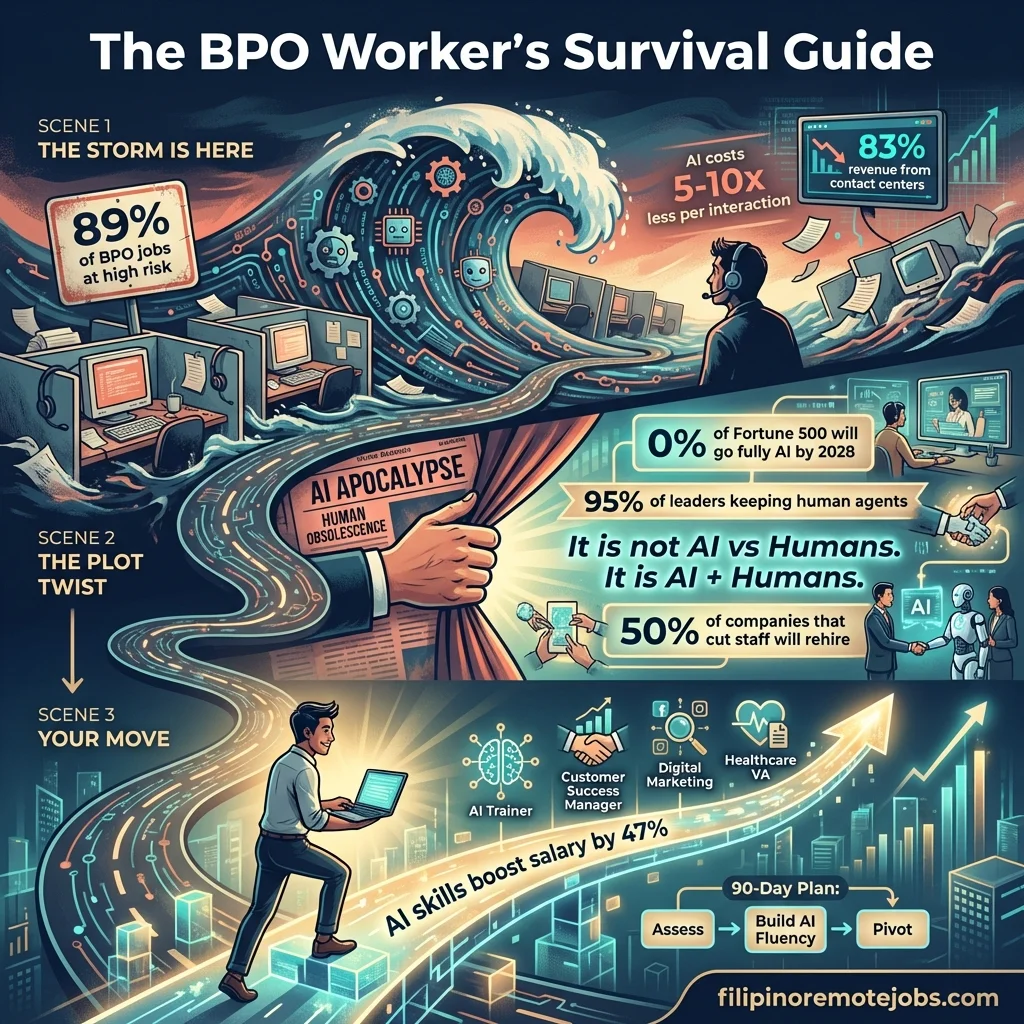
Statistics sourced from: IBPAP (IT-BPM industry data), Gartner (AI and customer service projections, Sept 2025, Dec 2025, Feb 2026, March 2025, Aug 2022), AMRO (Philippine AI adoption), IMF (February 2025 AI exposure report), ILO (2016 BPO automation risk report), Klarna (public statements and earnings reports), Dukaan (CEO public statements, 2023), Teleperformance (Sanas investment), Digital 2026 Report by Meltwater/We Are Social (ChatGPT adoption), EF Education First (2025 English Proficiency Index), Tony Blair Institute (Philippine AI economic projections), World Economic Forum (Future of Jobs Report 2025), PIDS/Philippine Tribune (AI salary premium), Bangko Sentral ng Pilipinas (OFW remittance data), Autodesk (2025 AI Jobs Report). Revenue and employment figures reflect 2025 industry reports.
Get Remote Jobs in Your Inbox
Join Filipino professionals getting curated remote job opportunities delivered every week. No spam, unsubscribe anytime.
Related Topics
Share this article
About Filipino Remote Jobs Team
The Filipino Remote Jobs Team is dedicated to helping Filipino professionals find legitimate remote work opportunities with international companies. We provide career advice, job search tips, and insights to help you land your dream remote job.
Related Articles
Virtual Assistant Jobs in the Philippines: How to Get Started With No Experience (2026)
Want virtual assistant jobs in the Philippines but have no experience? This guide covers the exact skills, free training resources, and platforms to land your first VA role.
Online Part-Time Jobs Philippines: 20 Best Options (2026)
Find the best online part-time jobs in the Philippines with salary ranges, skill requirements, and where to apply. From data entry to web development.
Top 15 Highest Paying Remote Jobs in the Philippines (2026)
Discover the highest paying jobs in the Philippines for remote workers. Salary ranges in USD and PHP, skills needed, and how to break into each role.