
Non-Voice Work From Home: 10 Remote Jobs for Filipinos Leaving the Call Center (2026)
Explore 10 non-voice work from home jobs in the Philippines that pay as much or more than BPO. Includes a step-by-step transition plan for call center workers.

It's 3 AM. Your AHT timer is ticking. The customer on the line is screaming about a billing error that isn't your fault. Your team leader is monitoring your screen. You haven't taken a bathroom break in four hours because your "adherence score" will drop.
Sound familiar?
If you're one of the 1.82 million Filipinos working in the BPO industry, you already know this routine. And you're probably already Googling "non-voice work from home jobs Philippines" during your 15-minute break.
Here's the good news: the non-voice remote job market has never been bigger. JobStreet alone lists over 900 non-voice work from home positions right now. And many of these jobs pay more than what you're earning on the phone -- without the headset, the irate callers, or the graveyard shifts.
This guide is your transition plan. Not just a list of jobs, but a step-by-step plan for getting out of the call center and into a remote career that doesn't wreck your health and your sleep schedule.
Why call center workers make great remote workers
Before we talk about where you're going, let's talk about what you're bringing with you. Because here's what most people get wrong: they think leaving the call center means starting from zero.
It doesn't. Your BPO experience is a launchpad.
Think about the skills you use every single shift:
- English proficiency -- You speak, write, and think in English for 8+ hours a day. The Philippines ranks 2nd in Asia for English proficiency (EF EPI 2024). That's not a small thing.
- Working US/AU hours -- You already know how to function on an American or Australian schedule. Most remote jobs need exactly this.
- Tech literacy -- CRM systems, ticketing platforms, multiple browser tabs, screen sharing -- you've been doing this since day one.
- Handling pressure -- If you can de-escalate an angry customer at 2 AM while your supervisor listens in, you can handle anything a remote job throws at you.
- Documentation -- Call notes, ticket summaries, escalation reports. You already know how to communicate in writing.
- Multitasking -- Talking, typing, searching the knowledge base, and logging the call simultaneously? That's a skill most people don't have.
According to a CCAP survey, the top three reasons BPO employees quit are better pay (69%), better growth opportunities (68%), and health-related reasons (46%). Non-voice remote work checks all three boxes.
You're not escaping. You're upgrading.
10 non-voice remote jobs you can start with BPO experience
Here are 10 roles where your call center skills transfer directly, along with what they actually pay. For comparison: entry-level call center agents earn P15,000-P22,000/month (~$270-$400). Keep that number in mind as you read.
1. Virtual assistant ($4-$8/hr)
The most common entry point for ex-BPO workers. You'll handle email, scheduling, calendar management, and admin tasks for a business owner -- typically based in the US, UK, or Australia.
Why it fits you: You already manage multiple tasks, communicate professionally, and use business tools daily. At $4/hr full-time, that's $640/month (around P36,000) -- already higher than most team leader salaries in the call center.
Difficulty: Low. You can start within 1-2 weeks of learning the basics.
2. Chat support / email support ($4-$7/hr)
Same customer service work you're doing now, minus the phone calls. You handle customer inquiries through live chat or email using tools like Zendesk, Freshdesk, or Intercom.
Why it fits you: Your de-escalation skills, product knowledge approach, and customer empathy transfer directly. You just type instead of talk.
Difficulty: Very low. This is the smoothest transition from call center work.
3. Data entry and research ($3-$6/hr)
Inputting, organizing, and verifying data in spreadsheets or databases. Some roles include online research -- finding contact information, pricing data, or market intelligence.
Why it fits you: Attention to detail from call documentation. Your typing speed (most call center agents type 40-60 WPM) is already above average.
Difficulty: Very low. Great for building remote work experience.
4. Social media manager ($5-$10/hr)
Creating, scheduling, and managing social media content for businesses. Includes writing captions, responding to comments, and tracking engagement.
Why it fits you: You understand brand voice and customer communication. If you already spend hours on social media (be honest), you might as well get paid for it.
Difficulty: Medium. You'll need to learn scheduling tools like Hootsuite or Buffer, and basic content creation with Canva.
5. Content moderator ($4-$7/hr)
Reviewing user-generated content (posts, comments, images, videos) to ensure it meets platform guidelines. Common with social media companies, marketplaces, and online communities.
Why it fits you: You're already trained to follow scripts and guidelines precisely. Content moderation is essentially quality assurance for online platforms.
Difficulty: Low. Some roles require thick skin (similar to handling difficult callers).
6. Bookkeeping / accounting assistant ($6-$12/hr)
Managing invoices, reconciling accounts, tracking expenses, and generating financial reports using tools like QuickBooks, Xero, or FreshBooks.
Why it fits you: If you've handled billing calls or worked on financial accounts, you already understand the basics. This is one of the highest-paying non-voice transitions.
Difficulty: Medium-High. You'll need to learn accounting software, but free QuickBooks and Xero courses are widely available online.
7. E-commerce assistant ($5-$8/hr)
Supporting online stores on Shopify, Amazon, or WooCommerce. Tasks include product listing, inventory management, order processing, and customer email responses.
Why it fits you: If you've worked retail or e-commerce accounts in BPO, you already understand the customer buying process. Even if you haven't, the organizational skills transfer well.
Difficulty: Medium. Learning one platform (start with Shopify) takes about 2-3 weeks.
8. Content writer / copywriter ($5-$15/hr)
Writing blog posts, website copy, email newsletters, product descriptions, or social media content. The pay range is wide because experienced writers with SEO skills earn significantly more.
Why it fits you: You write in English professionally every day. Call notes, email responses, chat conversations -- that's writing practice. The jump to content writing is smaller than you think.
Difficulty: Medium. Start by writing sample articles. Learn basic SEO through free HubSpot or Google courses.
9. Graphic designer ($5-$15/hr)
Creating visual content: social media graphics, presentations, marketing materials, logos, and website elements.
Why it fits you: This one requires learning a new skill (Canva or Figma), but if you have any creative inclination, it's one of the highest-ceiling non-voice roles. Your understanding of brand communication from BPO helps you design with purpose.
Difficulty: High. Requires dedicated learning time, but Canva makes it accessible for beginners.
10. Real estate virtual assistant ($5-$10/hr)
Supporting US, UK, or Australian real estate agents with lead management, listing coordination, CRM updates, transaction coordination, and email follow-ups.
Why it fits you: Real estate VAs are in huge demand, and the role relies heavily on communication skills, organization, and CRM experience -- all things you already have from BPO.
Difficulty: Medium. Real estate terminology takes a few weeks to learn, but the workflow is straightforward.
The salary math
Let's put this in perspective. Even at the lower end of these ranges:
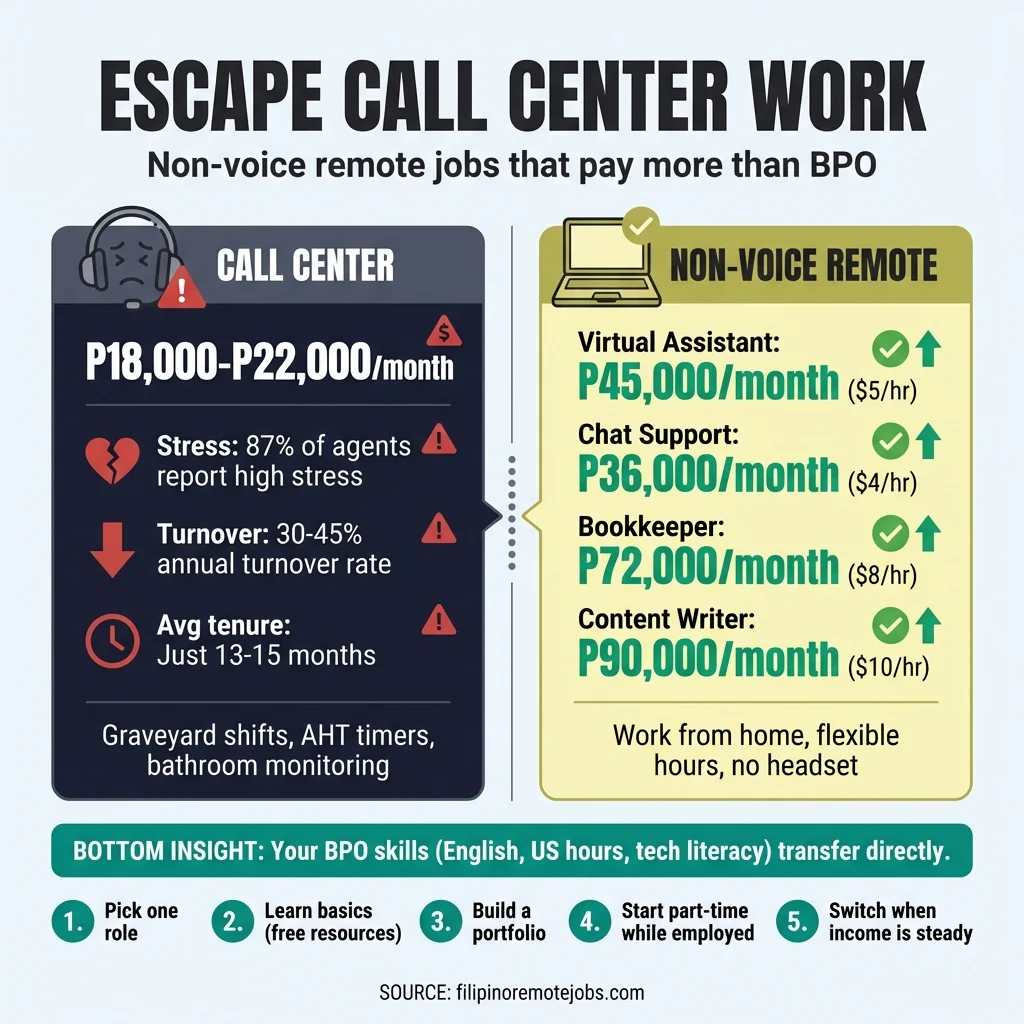
- A VA earning $5/hr full-time = $800/month = roughly P45,000
- A bookkeeper earning $8/hr full-time = $1,280/month = roughly P72,000
- A content writer earning $10/hr = $1,600/month = roughly P90,000
Compare that to your P18,000-P25,000 call center salary. And you're working from home -- whether that's a condo in BGC, your family's house in Cebu, or your lola's place in the province. No commute, no bathroom monitoring, no graveyard shift.
How to make the switch (step-by-step)
Don't quit your call center job tomorrow. Here's how to make the transition without risking your income. It takes diskarte, not luck.
Step 1: Pick one role and learn the basics
Look at the list above and choose one role that fits your skills and interests. Not three. Not five. One.
Then learn the basics using free resources:
- Virtual Assistant: YouTube channels like "Filipino VA Academy" + Google Workspace training
- Chat Support: Your existing BPO skills already cover this. Practice with Zendesk's free trial
- Bookkeeping: Free QuickBooks tutorials on YouTube + Coursera (audit mode)
- Content Writing: HubSpot Content Marketing certification (free) + Google's SEO course
- Social Media: Meta Blueprint courses (free) + Canva design tutorials
- E-commerce: Shopify's free learning resources + Amazon FBA YouTube tutorials
Not sure which skills to focus on? Check out our guide to the most in-demand skills for Filipino remote workers.
Step 2: Build a simple portfolio
You don't need client work to have a portfolio. Create samples:
- VA: Make a mock email management plan or a sample weekly report
- Writer: Write 3 blog posts on topics you know well
- Designer: Create 5 social media graphics for a fictional business using Canva
- Bookkeeper: Do a sample reconciliation using dummy data
Put these on a free Notion page, Google Drive folder, or simple Canva portfolio.
Step 3: Set up profiles on job platforms
Create profiles on at least 2-3 platforms (more on where to find jobs below). Include:
- A professional photo
- Your BPO experience framed as transferable skills
- Your new portfolio
- Available hours (including US timezone overlap)
For LinkedIn specifically, optimize your profile for remote work -- it makes a real difference when recruiters are searching.
Step 4: Start part-time while still employed
This is the most important step. Don't quit your BPO job until you have income from remote work.
Use your rest days and off-hours to take on small projects or part-time roles. Many non-voice remote jobs offer flexible schedules -- you can work 10-20 hours per week while keeping your call center salary as a safety net.
Step 5: Go full-time when you have steady income
Once you're consistently earning from remote work -- ideally matching or exceeding your call center salary -- make the switch. Give proper notice. Don't burn bridges.
A good benchmark: when you have at least 2 months of expenses saved AND a steady remote income stream, you're ready.
Where to find non-voice remote jobs
Filipino Remote Jobs (that's us)
We focus specifically on remote jobs for Filipino workers. No call center spam -- just legitimate non-voice remote opportunities from companies worldwide.
Browse current non-voice job openings
OnlineJobs.ph
The largest Philippine-specific remote job board. Filter by "non-voice" or specific roles like "virtual assistant" or "content writer." Quality varies, so vet employers carefully -- read our guide on how to spot remote job scams.
Upwork and Fiverr
Good for building experience and getting your first clients. Upwork works better for long-term contracts, Fiverr for project-based work. The platforms take a percentage, but they're a solid starting point.
Underrated for remote job hunting. Set your headline to your target role (e.g., "Virtual Assistant | Email & Calendar Management"), turn on "Open to Work" for recruiters, and filter job searches by "Remote." Check out our LinkedIn optimization guide for more tips.
Facebook groups
Join communities like "Filipino Virtual Assistant," "WFH Squad PH" (43K+ members on JobStreet), and "Buhay Digital." Many clients post jobs directly in these groups. Just be careful of scams -- legitimate jobs never ask you to pay upfront.
Common mistakes when leaving call center work
Quitting before you have backup income
The number one mistake. Call center work is frustrating, but a paycheck is a paycheck. Build your remote income stream while still employed. The transition typically takes 1-3 months of part-time effort.
Applying to everything instead of specializing
Sending 100 generic applications doesn't work. Pick one role, learn it well, and apply to positions where your skills match. Clients can tell when you've customized your application versus copy-pasting.
Underpricing yourself
Many ex-BPO workers quote rock-bottom rates because they feel like beginners. You're not. You have years of professional experience in English communication, customer handling, and business processes. Research market rates and negotiate accordingly.
Ignoring the skills you already have
Don't list "no experience" on your remote job profiles. You have experience. Your call center skills -- communication, multitasking, tech literacy, working with international clients -- are exactly what remote employers want. Frame them as the assets they are.
Your call center experience is your ticket out
Let's recap. The BPO industry has a 30-45% annual turnover rate. 87% of agents report high workplace stress. The average tenure is just 13-15 months.
If you're reading this, you probably already know all of that firsthand.
The opportunity is real: non-voice remote jobs are growing, they pay competitively (often better than call center work), and your BPO experience gives you a head start that most applicants don't have.
Here's what to do next:
- Pick one role from the list above
- Spend 2-3 weeks learning the basics (free resources)
- Build a simple portfolio
- Start applying part-time while keeping your current job
- Make the full switch when you have steady remote income
You don't need to keep taking calls at 3 AM to earn a living. The skills you built in the call center are valuable -- you just need to point them in a better direction.
Ready to start? Browse non-voice remote jobs on Filipino Remote Jobs or check out our complete guide to getting a remote job in the Philippines.
Salary data compiled from HireTalent.ph (2026 survey of 2,000 professionals), ScoutTalented.com, SmartOutsourcingSolution.com, and TTEC Philippines. Ranges represent typical rates for direct-hire remote roles; agency rates may be lower. Call center salary data from Indeed Philippines, Glassdoor, and SalaryGrades.ph. BPO industry statistics from IBPAP and CCAP.
Quick reference
Save this infographic for your career transition:
Get Remote Jobs in Your Inbox
Join Filipino professionals getting curated remote job opportunities delivered every week. No spam, unsubscribe anytime.
Related Topics
Share this article
About Filipino Remote Jobs Team
The Filipino Remote Jobs Team is dedicated to helping Filipino professionals find legitimate remote work opportunities with international companies. We provide career advice, job search tips, and insights to help you land your dream remote job.
Related Articles
Virtual Assistant Jobs in the Philippines: How to Get Started With No Experience (2026)
Want virtual assistant jobs in the Philippines but have no experience? This guide covers the exact skills, free training resources, and platforms to land your first VA role.
Online Part-Time Jobs Philippines: 20 Best Options (2026)
Find the best online part-time jobs in the Philippines with salary ranges, skill requirements, and where to apply. From data entry to web development.
Top 15 Highest Paying Remote Jobs in the Philippines (2026)
Discover the highest paying jobs in the Philippines for remote workers. Salary ranges in USD and PHP, skills needed, and how to break into each role.