
OnlineJobs.ph Alternatives: Upwork vs VirtualStaff.ph Comparison for Filipinos (2026)
Looking for OnlineJobs.ph alternatives? Compare fees, scam risks, and job quality across OnlineJobs.ph, Upwork, and VirtualStaff.ph. Written for Filipino job seekers.
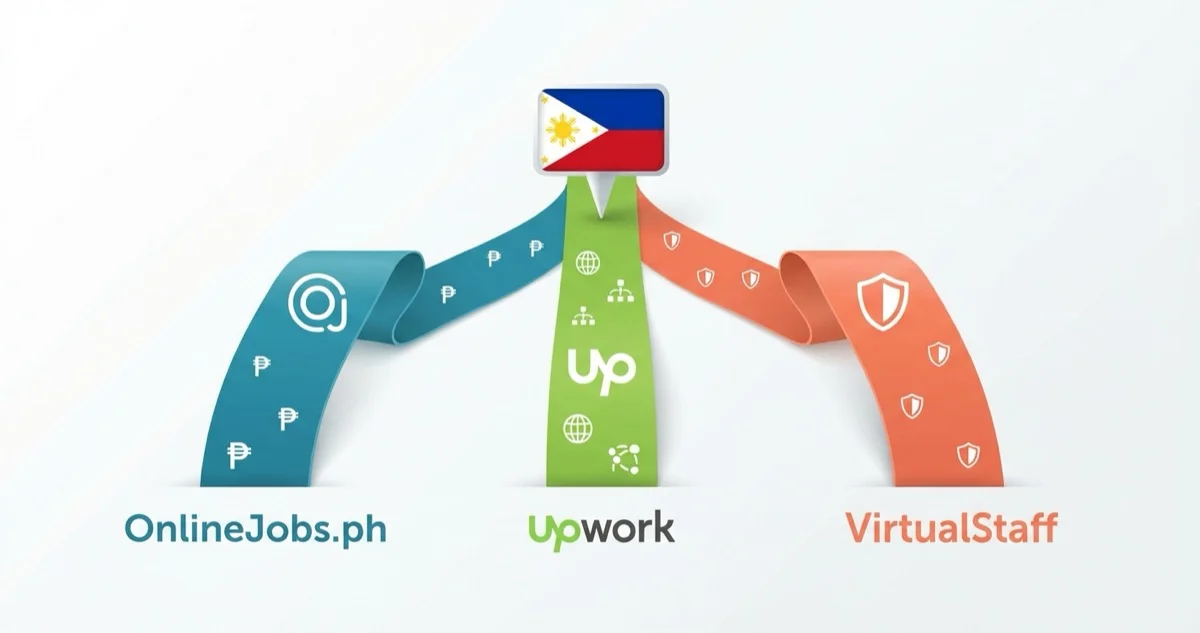
Every platform comparison you've read was written for employers deciding where to hire. Here's the first one written for you—the Filipino job seeker trying to figure out where to actually find work.
If you're comparing OnlineJobs.ph vs Upwork vs VirtualStaff.ph, you've probably noticed something frustrating: most "reviews" are either written by the platforms themselves or by employers sharing their hiring experience. Neither helps you decide where to spend your time applying.
With over 1.5 million Filipinos now working in online freelancing and remote work, choosing the right platform matters. The wrong choice means wasted applications, lost earnings to fees, or worse—falling for scams.
This guide covers the honest pros and cons of each platform from a job seeker's perspective, plus specific recommendations based on your situation.
Quick comparison table
| Factor | OnlineJobs.ph | Upwork | VirtualStaff.ph |
|---|---|---|---|
| Cost to join | Free | Free | Free |
| Cost to apply | Free | Connects ($) | Free |
| Platform fees | 0% | 0-15% (variable) | 0% |
| Payment protection | None | Escrow | Partial |
| Scam risk | Higher | Lower | Lower |
| Competition | Very high | Global, fierce | Moderate |
| Job types | Long-term VA roles | Project & contract | Long-term roles |
| Trustpilot rating | 3.7/5 | N/A | 4.5/5 |
| Best for | Keeping 100% of pay | Specialists, global clients | Safer experience |
OnlineJobs.ph — the OG Filipino job board
OnlineJobs.ph (OLJ) is the original platform specifically connecting Filipino workers with international employers. With over 2 million worker profiles and 100,000+ registered companies, it's the largest Philippines-focused remote job platform.
How it works (for job seekers)
Signing up is free. You create a profile, browse job listings, and apply directly to employers. No middleman—you communicate directly with potential employers and negotiate your own salary.
Payment is arranged between you and the employer. Most use Wise, PayPal, Payoneer, or direct bank transfer. OLJ doesn't process payments or take any cut.
The good
You keep 100% of your earnings. Unlike Upwork's fees, every peso you negotiate is yours. For someone earning $800/month, that's potentially $80+ saved—nearly ₱4,500.
Long-term positions are common. Most employers on OLJ want ongoing staff, not one-off projects. More job stability once you land a role.
Employers specifically want Filipinos. You're not competing with freelancers from 195 countries. Every employer on OLJ chose this platform because they want to hire from the Philippines.
The bad
Competition is brutal. Popular job postings receive hundreds of applications. Standing out requires a polished profile and cover letter.
Scam postings slip through. This is the biggest complaint on Reddit's r/buhaydigital. Common scams include:
- "Training periods" that never lead to real jobs
- Requests to pay for equipment or training materials
- Employers who disappear after you complete "test tasks"
Read our guide on how to spot and avoid remote job scams before applying.
No payment protection. If an employer doesn't pay, you have limited recourse. OLJ doesn't mediate disputes or guarantee payment.
The interface feels dated. The website works, but it hasn't had a major update in years. Search and filtering could be better.
Best for
- Virtual assistants seeking long-term employment
- Those who want to keep 100% of their earnings
- Experienced remote workers who can spot red flags
Upwork — the global freelance marketplace
Upwork is the world's largest freelancing platform with 18 million+ registered freelancers globally. It's not Philippines-specific, meaning you compete with talent from everywhere.
How it works (for job seekers)
Joining is free, but applying costs money. Upwork uses "Connects"—you spend Connects to submit proposals, and Connects cost real money (roughly $0.15 each, with most jobs requiring 2-6 Connects per application).
When you win a job, Upwork handles everything: contracts, time tracking (for hourly jobs), and payment processing through escrow.
The good
Payment protection through escrow. For fixed-price jobs, money is held in escrow before you start. For hourly work, their Work Diary system protects logged hours. Getting stiffed is rare.
Access to global clients. You're not limited to employers specifically seeking Filipinos. This opens doors to higher-paying clients who might not know about OLJ.
Professional profile with reviews. Your profile showcases your portfolio, skills tests, and client reviews. A strong profile becomes a genuine asset over time.
Higher-paying project work available. Specialized skills like development, design, or technical writing can command significantly higher rates than typical VA work.
The bad
Variable service fees take a cut. As of May 2025, Upwork charges 0-15% per contract based on factors like supply/demand, project type, and your profile. Most freelancers pay around 10%. On a $1,000 project, that's $100 gone.
Connects cost money to apply. You're paying before you even win work. New freelancers can burn through their monthly free Connects quickly, then pay $15+ monthly just to keep applying.
Global competition is fierce. You're competing with freelancers from lower-cost countries (India, Pakistan, Bangladesh) AND expensive Western freelancers. Standing out takes time.
The algorithm favors established freelancers. New profiles get buried. Many struggle to land their first few clients because the system recommends freelancers with existing reviews.
Best for
- Skilled specialists (developers, designers, writers)
- Those who want project-based work rather than employment
- Building a portfolio of global clients
- People who value payment security over keeping 100% of earnings
VirtualStaff.ph — the managed marketplace
VirtualStaff.ph is a newer platform positioning itself between OLJ's free-for-all approach and Upwork's fees. It focuses on the Philippines market but with more vetting on both sides.
How it works (for job seekers)
You create a free profile and browse jobs. The platform does more matching—employers can search for you based on skills, and you'll get notified of relevant opportunities.
VirtualStaff.ph handles some administrative aspects like compliance and HR support, positioning itself as more than just a job board.
The good
Curated listings with fewer scams. Employers go through more verification. Their 4.5/5 Trustpilot rating (670 reviews) reflects this—significantly higher than OLJ's 3.7/5.
Some payment protection. While not as robust as Upwork's escrow, there's more structure than OLJ's "figure it out yourselves" approach.
Less competition than OLJ. As a growing platform, there are fewer job seekers per listing. Your applications get more visibility.
Growing platform momentum. Active development and marketing means new job listings are consistently added.
The bad
Fewer job listings overall. The trade-off for quality is quantity. You'll find fewer opportunities compared to OLJ.
Some employers expect lower rates. The platform attracts cost-conscious employers who may push for below-market rates.
Platform controls more of the relationship. Less direct communication with employers in some cases, which can feel limiting if you prefer autonomy.
Best for
- Those wanting a safer, more managed experience
- Entry-level remote workers who need protection
- Job seekers frustrated with OLJ scams
- People who prefer structure over complete autonomy
Head-to-head: which platform wins?
There's no single "best" platform—it depends on your situation. Here are my recommendations based on where you are in your career:
For entry-level / no experience
Start with VirtualStaff.ph.
Lower scam risk means you won't waste time on fake opportunities. Less competition means your profile actually gets seen. Once you have 6-12 months of remote work experience, expand to other platforms.
For experienced VAs / specialists
Use OnlineJobs.ph for long-term roles, Upwork for project work.
Your experience helps you spot scams on OLJ, and keeping 100% of your earnings matters more as your rate increases. Upwork makes sense for specialized project work where payment protection is worth the fee.
For highest earning potential
Upwork for specialists, direct clients for everyone.
If you have in-demand skills (development, design, specialized marketing), Upwork's global client base offers higher rates than Philippines-focused platforms. But the real money is in direct clients—more on that below.
For job security / long-term work
OnlineJobs.ph wins for stable employment.
Most OLJ employers want ongoing staff, not project freelancers. If you want the closest thing to traditional employment (but remote), this is your best bet.
The platform nobody talks about: direct hiring
Here's what these platforms don't want you to realize: the best opportunities often aren't on platforms at all.
Limiting yourself to job platforms means:
- Competing with thousands of other applicants
- Potentially losing money to fees
- Depending on platform algorithms and rules
How to find direct clients:
-
Company career pages — Many remote-friendly companies post jobs directly on their websites. Check companies you'd love to work for.
-
LinkedIn — Optimize your profile (see our guide on LinkedIn profile optimization), connect with hiring managers, and apply to posted jobs.
-
Networking — Join Filipino remote work communities on Facebook and Discord. Maraming opportunities are shared before hitting public job boards.
-
Curated job boards — Sites like Filipino Remote Jobs focus on quality over quantity, curating legitimate opportunities from companies specifically seeking Filipino talent.
My recommendation: use multiple platforms strategically
Don't put all your eggs in one basket. Here's a strategic approach:
If you're just starting out:
- Create a VirtualStaff.ph profile (safety first)
- Set up an OLJ profile but be cautious about applications
- Apply to 5-10 jobs per week across platforms
- Focus on building experience and reviews
If you're experienced:
- Maintain active profiles on OLJ and Upwork
- Use OLJ for long-term VA positions
- Use Upwork for higher-paying project work
- Actively pursue direct clients through LinkedIn and networking
Managing multiple profiles:
- Keep your resume and portfolio updated in one place (Google Drive works)
- Use a spreadsheet to track applications and follow-ups
- Set calendar reminders to refresh profiles weekly
- Tailor your approach to each platform's strengths
Key takeaways
The OnlineJobs.ph vs Upwork debate misses the point—the right platform depends on your situation:
-
OnlineJobs.ph is best for long-term VA work where keeping 100% of your pay matters. Just watch out for scams.
-
Upwork makes sense for skilled specialists who want payment protection and access to global clients. Accept the fees as a cost of doing business.
-
VirtualStaff.ph offers a middle ground—safer than OLJ, cheaper than Upwork. Great for entry-level workers or those burned by bad experiences elsewhere.
-
Don't rely on any single platform. Diversify your job search across multiple platforms AND direct opportunities.
Ready to start your search? Browse curated remote jobs from companies actively hiring Filipino talent—no platform fees, no scams, just legitimate opportunities.
Quick reference
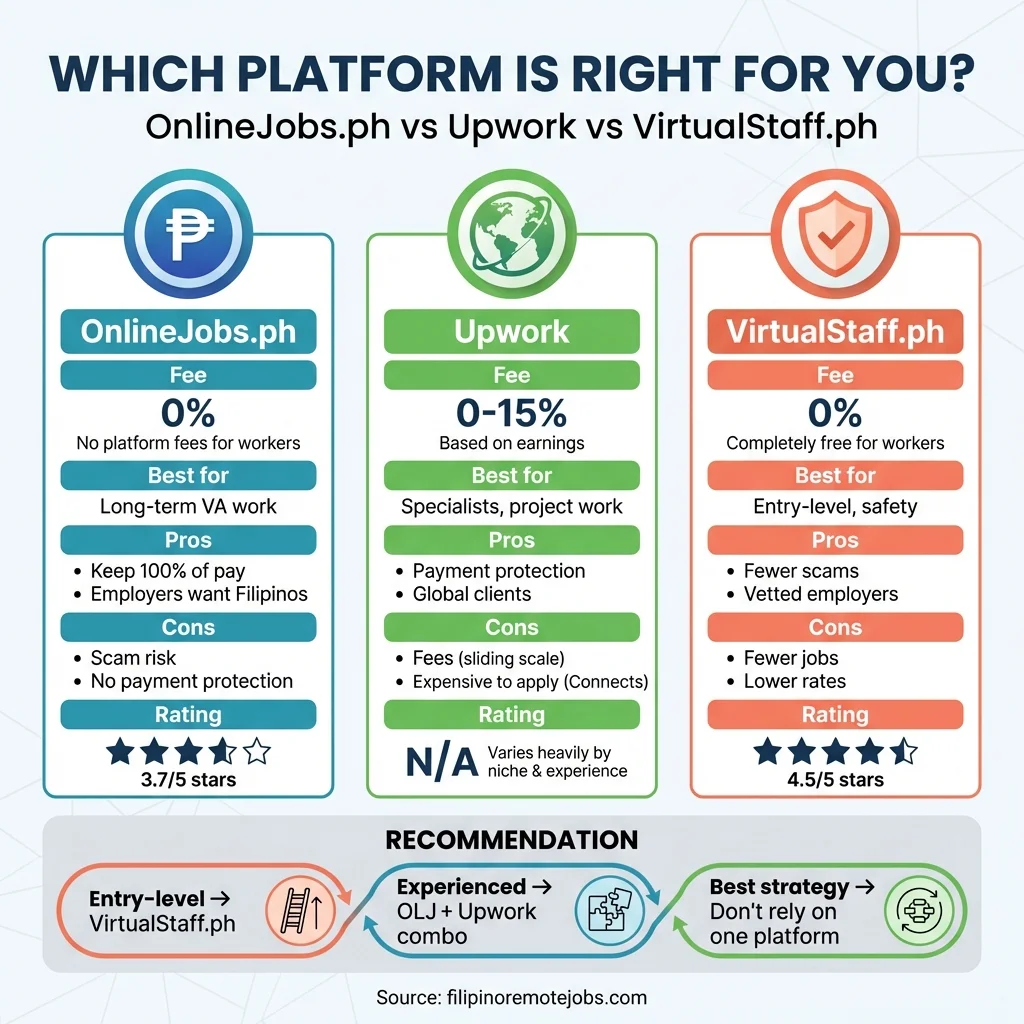
Save this infographic to help you choose the right platform:
Get Remote Jobs in Your Inbox
Join Filipino professionals getting curated remote job opportunities delivered every week. No spam, unsubscribe anytime.
Related Topics
Share this article
About Filipino Remote Jobs Team
The Filipino Remote Jobs Team is dedicated to helping Filipino professionals find legitimate remote work opportunities with international companies. We provide career advice, job search tips, and insights to help you land your dream remote job.
Related Articles
Virtual Assistant Jobs in the Philippines: How to Get Started With No Experience (2026)
Want virtual assistant jobs in the Philippines but have no experience? This guide covers the exact skills, free training resources, and platforms to land your first VA role.
Online Part-Time Jobs Philippines: 20 Best Options (2026)
Find the best online part-time jobs in the Philippines with salary ranges, skill requirements, and where to apply. From data entry to web development.
Top 15 Highest Paying Remote Jobs in the Philippines (2026)
Discover the highest paying jobs in the Philippines for remote workers. Salary ranges in USD and PHP, skills needed, and how to break into each role.