
How to Build a Remote Work Portfolio with No Experience (Filipino Guide 2026)
Build a remote work portfolio even with zero experience. Free tools, mock project templates by role, and a weekend action plan for Filipino job seekers.
Every remote job listing asks for experience. You can't get experience without a job. And you can't get a job without a portfolio.
This catch-22 stops thousands of Filipino job seekers before they even start. But here's what most people miss: you don't need clients to build a remote work portfolio. You need diskarte — the resourcefulness to create proof of your skills from scratch.
This guide gives you role-specific mock projects, free tools, and a weekend action plan to build a portfolio that gets you hired — even with zero professional experience.
Why a portfolio beats a resume for remote jobs
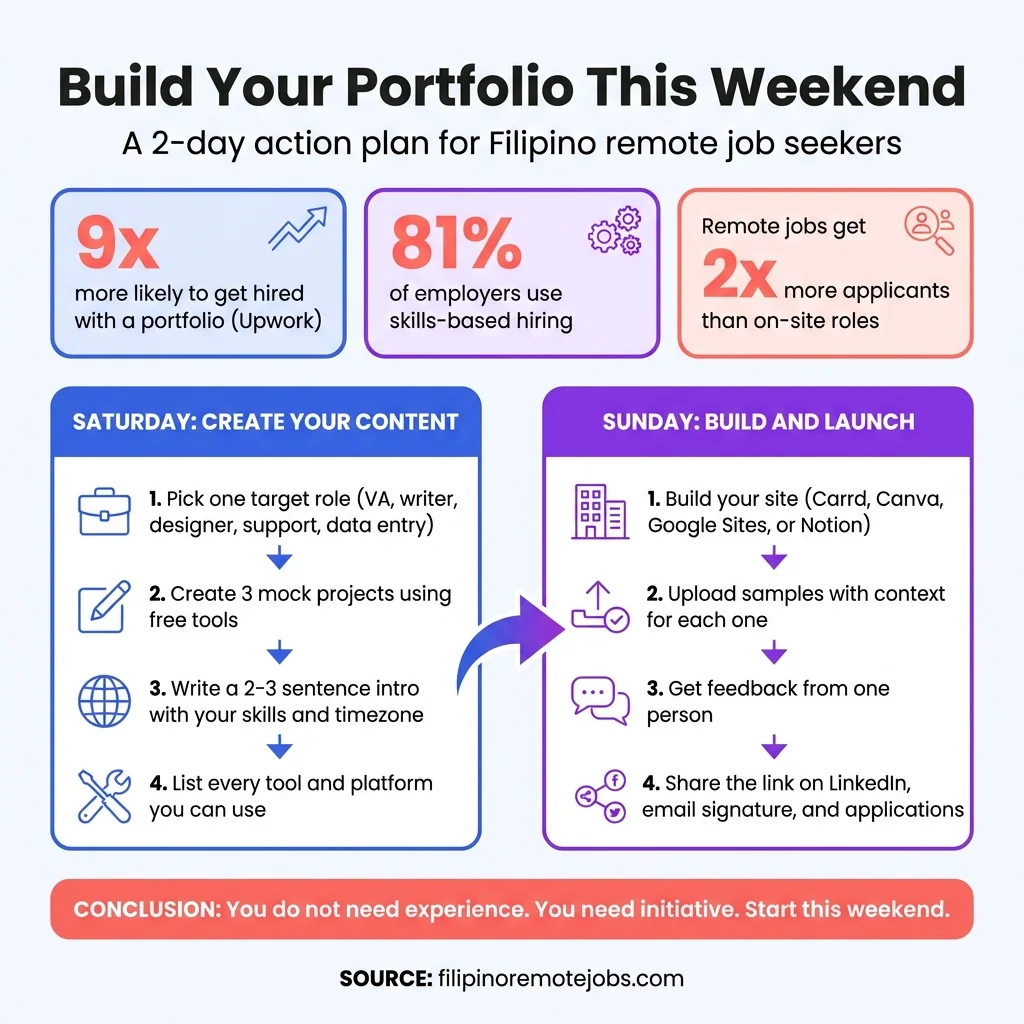
When a US or Australian employer posts a remote role, they might get hundreds of applicants — remote positions attract over 2x more applications than on-site jobs. Your resume says you're skilled. So does everyone else's.
A portfolio is different. It shows what you can do instead of just claiming it. According to Upwork's own platform data, freelancers with a published portfolio get hired nine times more often than those without one.
This matters even more for remote work than traditional jobs. International employers can't call your previous boss for a reference. They can't watch you work in person. Your portfolio bridges that trust gap — it's tangible proof that you can deliver.
With 81% of employers now saying they use skills-based hiring, what you can demonstrate matters more than what's on your diploma. Even a simple portfolio with 3-5 mock projects puts you ahead of most applicants who only submit a resume.
What to include (and what to leave out)
The essentials
Every remote work portfolio needs these five things:
- Short intro — Who you are, what you do, and your timezone. Two to three sentences. Example: "I'm a virtual assistant based in Cebu, available during US business hours. I specialize in email management, calendar scheduling, and Notion workspace setup."
- Tools and platforms — List specific software (Google Workspace, Canva, Trello, Slack, Notion), not vague soft skills like "team player."
- 3-5 work samples — Mock projects are completely fine. We'll cover exactly what to build in the next section.
- Services you offer — What can someone hire you to do? Be specific. "Social media management for small businesses" beats "marketing."
- Contact info — Email and LinkedIn at minimum. Make it easy to reach you.
Common mistakes to avoid
- Generic statements like "I'm a hardworking, dedicated professional." Every applicant says this. Your portfolio samples should show it instead.
- Irrelevant work. Applying for VA roles? That college essay on Philippine literature isn't helping. Match samples to your target role.
- Listing rates upfront. Say "available on request." Let the employer see your value first.
Mock projects that impress (by role)
Mock projects aren't fake work — they're demonstrations of real skills. Here's exactly what to build for the most in-demand Filipino remote roles.
Virtual assistant
Build a sample Notion dashboard with a weekly task tracker, a content calendar template, and a mock client onboarding checklist. Create a professional email response template — the kind a VA would send to reschedule a meeting or follow up on a deliverable. Add a sample travel itinerary for a fictional client. VAs sell organization, so make everything clean and structured.
Content writer
Write 2-3 blog posts (500-800 words each) on topics in a specific niche — health, tech, real estate, or travel. Publish them on Medium or a free WordPress site so they have a live URL. Include a brief note on each: "Written as a portfolio sample targeting [audience]." Having published links beats sending Word documents every time.
Graphic designer
Create a mini branding package for a fictional business: logo, color palette, and 3-5 social media templates in Canva (Instagram posts, Facebook covers, story templates). Redesign a real local business's social media post as a before/after comparison — just note that it's a mock project. Show range and consistency.
Customer support
Write 5 sample ticket responses covering common scenarios: refund request, shipping delay, billing question, product complaint, and general inquiry. Show empathy, clarity, and problem-solving in each. Format them like real help desk tickets with subject lines and structured responses.
Data entry / bookkeeper
Download a public dataset from Kaggle or a Philippine government site. Clean it up in Google Sheets, organize it with proper formatting, and create a summary dashboard with charts. For bookkeeping, build a sample monthly expense tracker with categories, formulas, and totals.
Here's how powerful this approach is. In Filipino freelancer communities, a common success pattern goes like this: a beginner creates mock social media content for a fictional local brand — say, "Kapeng Barako Cafe" — with graphics, captions, and a content calendar. They post it as portfolio samples, and within weeks a real client reaches out because they liked the work. The client doesn't care that the brand was fictional. They care that the work looks professional.
Free tools to build your portfolio today
You don't need to spend a single peso:
| Tool | Best for | Why it works |
|---|---|---|
| Carrd.co | Simple portfolio site | Free plan, one page, looks professional. Up and running in under an hour. |
| Canva | Design portfolios + PDF portfolios | Drag-and-drop templates. Search "portfolio" in their template library. |
| Google Sites | No-code portfolio | Completely free, easy to update, linked to your Google account. |
| Notion | VA portfolios | Great for showing organizational skills. Share a public page link. |
| Medium | Writer portfolios | Built-in audience, clean formatting, free publishing. |
| GitHub Pages | Developer portfolios | Free hosting, shows technical ability. |
Match the tool to your role. Notion for VAs (it shows you know the tool employers use). Medium for writers (live published articles). Canva for designers (shows design skills in the portfolio itself). GitHub for developers (demonstrates technical ability).
Your weekend action plan
Stop overthinking. Here's how to go from nothing to a live portfolio in two days.
Saturday: create your content
- Pick your target role — VA, writer, designer, support, or data entry. Just one.
- Create 3 mock projects using the blueprints above. Set a timer for 2 hours per project.
- Write your intro — 2-3 sentences about who you are and what you offer.
- List your tools — Every platform, app, and software you can use. Include the basics (Google Docs, Sheets, Slides) because they count.
Sunday: build and launch
- Choose your platform — Carrd for simplicity, Canva for design, Notion for VAs.
- Upload your samples — Add context to each one: what it is, what skill it demonstrates, and who it's for.
- Get feedback from one person — A friend, a classmate, a family member. Fresh eyes catch mistakes you won't.
- Share the link everywhere — Add it to your LinkedIn profile, your email signature, and every job application you send.
That's it. By Sunday evening you have a portfolio.
Real stories that prove it works
Kaila Sharlene left a BPO data entry job in 2011 with no freelancing experience. She applied persistently on Upwork and landed her first client in 2012. When that client asked her to build a website — something she'd never done — she said yes and taught herself through late nights on Google. That delivered project became the foundation of a new specialty. Today she's a specialist web designer who receives inbound client inquiries instead of chasing jobs.
Nate, a Filipino freelancer profiled by Parallax, taught himself graphic design through YouTube while still in university. He posted his personal projects in his university's Facebook group, offering design services at an hourly rate. His first paid gig: a logo for a small bakery at $10. Through referrals, he grew his client base across Singapore, Dubai, the USA, and Spain.
Cherry, a former call center team manager, switched to freelancing after over a decade in BPO. She faced two months of rejections. Her strategy: she stated on her profile that she was a beginner committed to learning, and applied for data entry positions as an entry point. After landing her first role, she expanded into Shopify, ClickFunnels, and Mailchimp management within eight months — all with the same client.
The common thread? They created opportunities before anyone gave them permission. They started small. They improved as they went.
Start this weekend
You don't need experience to build a portfolio. You need initiative.
Here's what to do right now:
- Pick one role you want to apply for
- Create one mock project — even just one
- Put it online using any free tool from the table above
Then browse remote job listings on Filipino Remote Jobs and start applying with your portfolio link attached. You can boost your credibility with free certifications, optimize your LinkedIn profile to match, or review the skills employers are looking for right now.
It won't be perfect — and it doesn't need to be. A messy portfolio beats no portfolio every single time. The catch-22 ends when you decide to break it.
Get Remote Jobs in Your Inbox
Join Filipino professionals getting curated remote job opportunities delivered every week. No spam, unsubscribe anytime.
Related Topics
Share this article
About Filipino Remote Jobs Team
The Filipino Remote Jobs Team is dedicated to helping Filipino professionals find legitimate remote work opportunities with international companies. We provide career advice, job search tips, and insights to help you land your dream remote job.
Related Articles
Virtual Assistant Jobs in the Philippines: How to Get Started With No Experience (2026)
Want virtual assistant jobs in the Philippines but have no experience? This guide covers the exact skills, free training resources, and platforms to land your first VA role.
Online Part-Time Jobs Philippines: 20 Best Options (2026)
Find the best online part-time jobs in the Philippines with salary ranges, skill requirements, and where to apply. From data entry to web development.
Top 15 Highest Paying Remote Jobs in the Philippines (2026)
Discover the highest paying jobs in the Philippines for remote workers. Salary ranges in USD and PHP, skills needed, and how to break into each role.